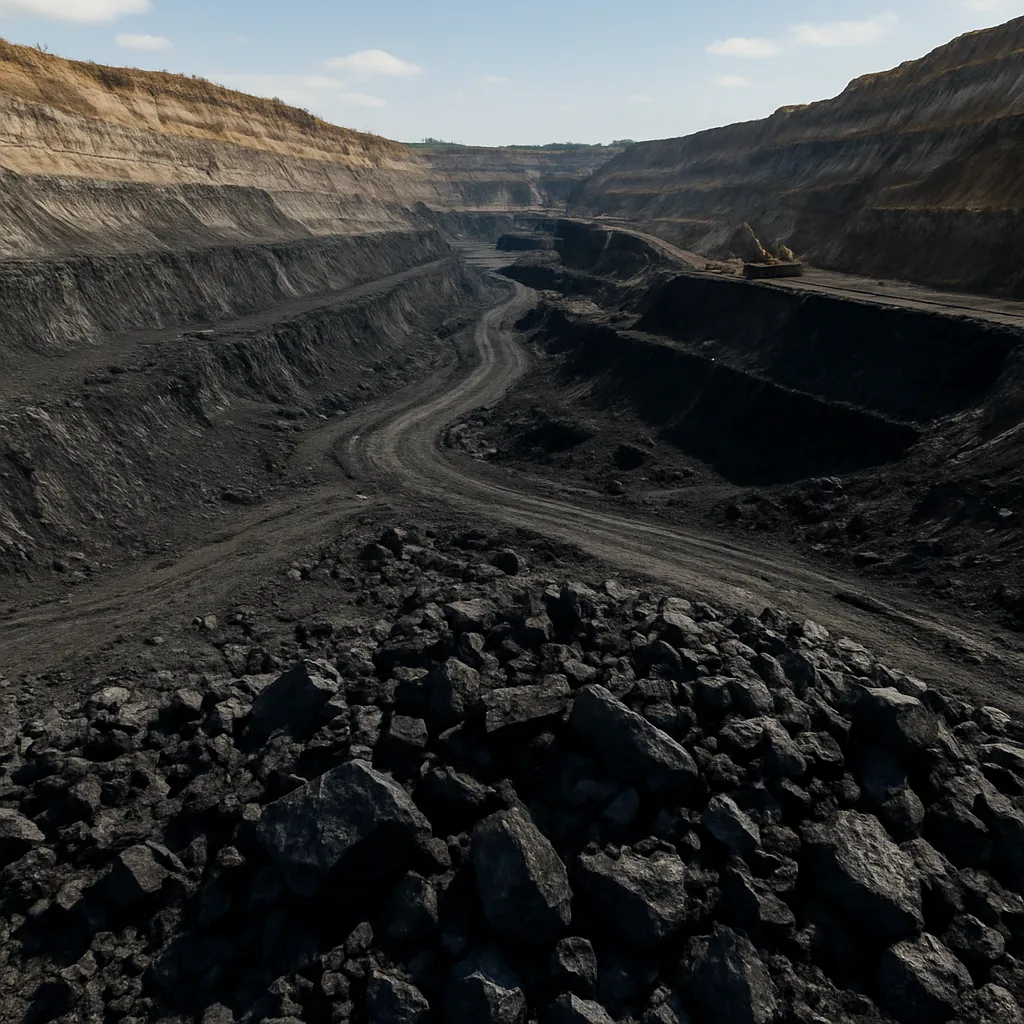
This article examines open-pit coal — one of the most visible and economically significant forms of fossil-fuel extraction. It covers where this coal is found, how it is mined, the economic and statistical context, industrial uses, environmental and social implications, and likely future trends. The aim is to give a balanced, data-informed overview useful for students, policy makers, industry observers and the general public.
Geography and Major Producing Regions
Open-pit coal occurs where relatively shallow seams of coal lie near the surface, allowing the economical removal of overburden and extraction by surface-mining methods rather than underground tunnelling. Globally, large open-pit coal operations concentrate in several major basins and countries.
- China: The world’s largest coal producer. Large surface mines exist in northern provinces (Shanxi, Inner Mongolia), northeastern provinces and in parts of Xinjiang. China’s coal industry includes both small, scattered pits and very large surface mines supplying local power plants and the steel sector.
- Australia: A leading exporter of both thermal and metallurgical coal. Major open-cut basins include the Bowen Basin (Queensland) and Hunter Valley (New South Wales). Australian mines are highly mechanized and many are among the world’s largest single-site producers.
- United States: The Powder River Basin (Wyoming and Montana) is notable for vast surface mines producing low-rank thermal coal used primarily for electricity. Appalachia also contains surface operations though historically more underground mining occurred there.
- Indonesia: Extensive open-pit mines on Kalimantan and Sumatra supply the seaborne thermal-coal market. Indonesia is one of the largest exporters of thermal coal and many mines are large-scale surface operations run by major private firms.
- Russia and Kazakhstan: Large open-pit and strip mines exist in Kuzbass (Kemerovo) and other regions with significant coal reserves, feeding domestic power and steel sectors and exports to neighbouring markets.
- Colombia: The Cerrejón mine in La Guajira is one of the largest open-pit coal mines in the world, chiefly focused on thermal-coal exports.
- South Africa: While much South African coal production is underground, there are significant open-pit operations in some basins supplying both domestic power (Eskom) and metallurgical needs.
Across many of these regions, open-pit operations dominate production by tonnage because they allow very high extraction rates and low operating costs per tonne compared with underground methods. Countries that supply global seaborne markets (Australia, Indonesia, Colombia, South Africa) rely heavily on surface mines for export volumes.
Mining Methods, Technology and Scale
Open-pit coal mining (also called surface mining, strip mining or open-cut mining) removes overlying rock and soil (overburden) to expose coal seams. The basic sequence is: cut benching into the seam, drill and blast or shear the coal, haul material with large trucks or conveyors, and progressively expand the pit. Modern large-scale mines employ an array of specialized heavy equipment.
- Excavation and haulage: Electric rope shovels, hydraulic excavators, draglines (where geologically suitable), and truck-and-shovel fleets are common. Draglines and very large shovels can move tens of thousands of cubic metres of overburden per day.
- Continuous miners and conveyor networks: In very large open-pit complexes, in-pit crushing and conveyor systems reduce trucking costs and increase logistic efficiency, sometimes moving coal directly to rail loadouts.
- Automation and digitalization: Fleet management systems, autonomous haul trucks, and remote-controlled shovels are increasingly common in major operations, improving safety and lowering unit costs.
- Scale: Some of the world’s largest open-pit coal mines produce tens of millions of tonnes per year. For example, large Powder River Basin mines and several Australian open-cuts have annual outputs often in the tens of millions of tonnes.
Surface mining favors certain geological conditions: relatively flat-lying seams, low strip ratios (the volume of overburden relative to coal), and seams thick enough to justify removal costs. Where seams are steeply dipping, deep, or thin, underground methods can be preferred.
Economic and Statistical Overview
Coal remains a major global commodity in the early 2020s despite structural declines in some regions. Below are headline statistics and economic patterns to frame the importance of open-pit coal.
Global production and reserves
- Global coal production (hard coal plus lignite) in recent years has been roughly in the range of about 7–8 billion tonnes annually, depending on year-to-year demand and policy shifts. The balance between thermal (power) and coking (metallurgical) coal varies by region.
- Proven global coal reserves are large, often reported on the order of around 1 trillion tonnes (proven). At current production rates this implies many decades of physical supply, though economic, environmental and policy factors will affect future extraction.
Major producing countries (approximate shares)
- China: ~45–50% of global coal production (single largest producer and consumer).
- India: Roughly 8–10% of global production, with most used domestically for power and industry.
- Indonesia: Among the top producers and a leading exporter of thermal coal.
- United States and Australia: Each contributes a large share — the US supplies domestic power needs and some exports; Australia is a dominant exporter to Asia and world markets.
These shares shift over time: China’s internal production and demand heavily influence global flows; Australia and Indonesia are critical suppliers to the Asian seaborne market.
Costs, prices and market dynamics
- Open-pit mining typically delivers lower cash costs per tonne than underground mining because of higher productivity, simpler logistics and lower labor intensity. This is why major export-oriented producers favor large surface mines where geology permits.
- Coal prices are volatile. Seaborne thermal-coal benchmark prices (e.g., Newcastle) spiked in 2021–2022 because of tight supplies, strong demand after COVID rebounds, and disruptions in some exporting countries; prices later moderated but volatility remains. Metallurgical (coking) coal can be even more volatile, tied to steel demand and specific supply disruptions.
- Export revenues: For countries like Australia and Indonesia, coal exports are a significant export earner and fiscal contributor via royalties and taxes. Port, rail and shipping capacity are integral parts of the coal value chain and are major determinants of competitiveness.
Employment and local economic impact
Open-pit coal operations are capital- and equipment-intensive and thus employ fewer workers per tonne of output than underground mining, but they still provide substantial local employment and generate secondary jobs in services, logistics and maintenance. Royalties and corporate taxes fund local and national budgets in many producing countries. The concentration of production in a few large-scale operations makes local economies sensitive to price cycles and mine life changes.
Industrial Uses and Market Dynamics
Coal’s primary uses are in power generation and steelmaking, which gives the commodity two distinct market segments with different price drivers and technological risks.
- Thermal coal: Burned in power plants to generate electricity and in some industrial processes. Thermal coal markets are shaped by seasonal power demand, fuel-switching (gas, renewables), and import dependence of major consumers (e.g., Japan, South Korea, many countries in Southeast Asia).
- Metallurgical (coking) coal: Required for blast-furnace steelmaking. This market is influenced by steel demand, production capacity, and availability of substitutes (e.g., direct reduced iron using hydrogen, which is still emerging). Metallurgical coal prices are typically higher and subject to different supply-demand cycles than thermal coal.
- Other uses: Coal is also used in cement production, various chemical feedstocks (coal-to-chemicals in some countries), and historically for heating and industrial process heat.
Seaborne trade matters: A large fraction of thermal coal traded internationally moves by sea from Australia, Indonesia, Russia, Colombia and South Africa to importing nations in Asia, Europe and beyond. Infrastructure constraints (port and rail capacity) often limit ramp-up of supply even when geological resources are ample.
Environmental, Social and Policy Issues
Open-pit coal mining creates pronounced environmental and social impacts that attract substantial regulatory, community and investor attention.
Environmental impacts
- Land disturbance: Open pits remove vegetation and soil over large areas, changing landscapes and ecosystems. Rehabilitation and progressive reclamation are required in many jurisdictions but vary in effectiveness.
- Water: Changes to surface and groundwater flows, risk of contamination (acid mine drainage where sulfide minerals are present), and competition for water with local users are common issues.
- Air quality and dust: Blasting, hauling and coal handling generate dust and airborne particulates, affecting local air quality and health.
- Greenhouse gases: Coal combustion is a major source of CO2 emissions. Across the energy system, coal remains a leading contributor to anthropogenic CO2, and methane emissions from coal mining (particularly underground operations) add to greenhouse-gas burdens.
Social issues
- Community displacement and land rights: Large open pits can require resettlement and provoke disputes with Indigenous peoples and local communities over land and resource access.
- Health and safety: While surface mining is generally safer than underground mining in terms of collapse risk, there remain hazards from heavy equipment, blasting and dust exposure.
- Economic dependency: Regions built around coal production face transition risks if markets contract, including unemployment and fiscal shortfalls.
Policy and regulatory environment
Energy and climate policies are reshaping the coal industry.
- Decarbonization targets and air-quality regulations in many OECD countries have led to plant retirements and reduced domestic demand for thermal coal.
- In contrast, developing economies with rising electricity demand (parts of Asia and Africa) still rely heavily on coal for affordable baseload generation, though many are adopting renewables and gas as alternatives.
- Carbon pricing, emissions standards, and potential deployment of carbon capture and storage (CCS) for coal combustion affect the future competitiveness of coal-fired power.
Reclamation, Mitigation and Technology Responses
Miners and regulators use various approaches to reduce environmental impacts and manage community relations.
- Progressive rehabilitation: Many large mining companies now reinstate topsoil, regrade benches, and establish vegetation and post-mining land uses (agriculture, forestry, lakes and recreation).
- Methane capture: In some coal regions, methane drainages and capture for power generation can reduce greenhouse-gas emissions and improve mine safety.
- Water management: Tailings and water treatment infrastructure are critical to prevent contamination and to manage water scarcity, including recycling systems.
- Technology: Greater automation reduces on-site workforce exposure and can improve precision in blasting and excavation, reducing overburden and waste.
- CCS and clean-coal technologies: Pilot projects and demonstrations exist, but CCS at scale remains expensive and has limited commercial deployment specifically for coal power to date.
Future Outlook and Key Trends
The future of open-pit coal will be shaped by a complex mix of geology, economics, policy, and technology.
- Regional divergence: Demand in advanced economies is likely to decline further as renewables, storage and gas expand. However, in parts of Asia and some emerging markets, coal (often sourced from open-pit mines) may remain important in the near to medium term for affordability and energy security.
- Price volatility and market shifts: Events such as extreme weather, geopolitical disruptions, and policy changes can cause sharp swings in coal prices and trade flows. The seaborne market remains sensitive to Chinese and Indian import behaviour as well as to Australian and Indonesian export policies.
- Mine life and repurposing: Some large surface mines have long nominal reserves but face uncertain long-term demand. Planning for mine closure, land rehabilitation and economic diversification of coal regions is becoming a key issue for governments and companies.
- Technological substitution: Innovations in steelmaking (e.g., hydrogen-based direct reduction) could reduce demand for metallurgical coal in the longer term, while advances in grid-scale storage and renewables can reduce thermal coal demand for power generation.
Selected Interesting Facts
- Several single open-pit coal mines rank among the world’s largest industrial sites by area and throughput; some produce tens of millions of tonnes per year from a single contiguous operation.
- Open-pit operations, because of their scale and mechanization, are often the most cost-competitive sources of seaborne thermal coal and are therefore central to international coal trade.
- Despite policy pressures, coal continues to supply roughly one-third of global electricity generation in the early 2020s, underlining its persistent role in energy systems where alternatives are not yet fully deployed.
Conclusion
Open-pit coal remains an important component of the global energy and materials system. It is characterized by large-scale, mechanized operations that deliver coal at relatively low unit cost and thus underpin export markets and domestic power systems in many countries. At the same time, the environmental footprint and carbon intensity of coal create increasing policy and market pressures, especially in regions pursuing aggressive decarbonization. The next decades will likely see regional divergence: contracting use in parts of the world balanced against persistent or even growing demand in others, at least in the medium term. How quickly technologies such as renewables, storage, alternative steelmaking routes, and carbon mitigation solutions scale will determine the pace at which open-pit coal’s prominence declines or is reshaped.