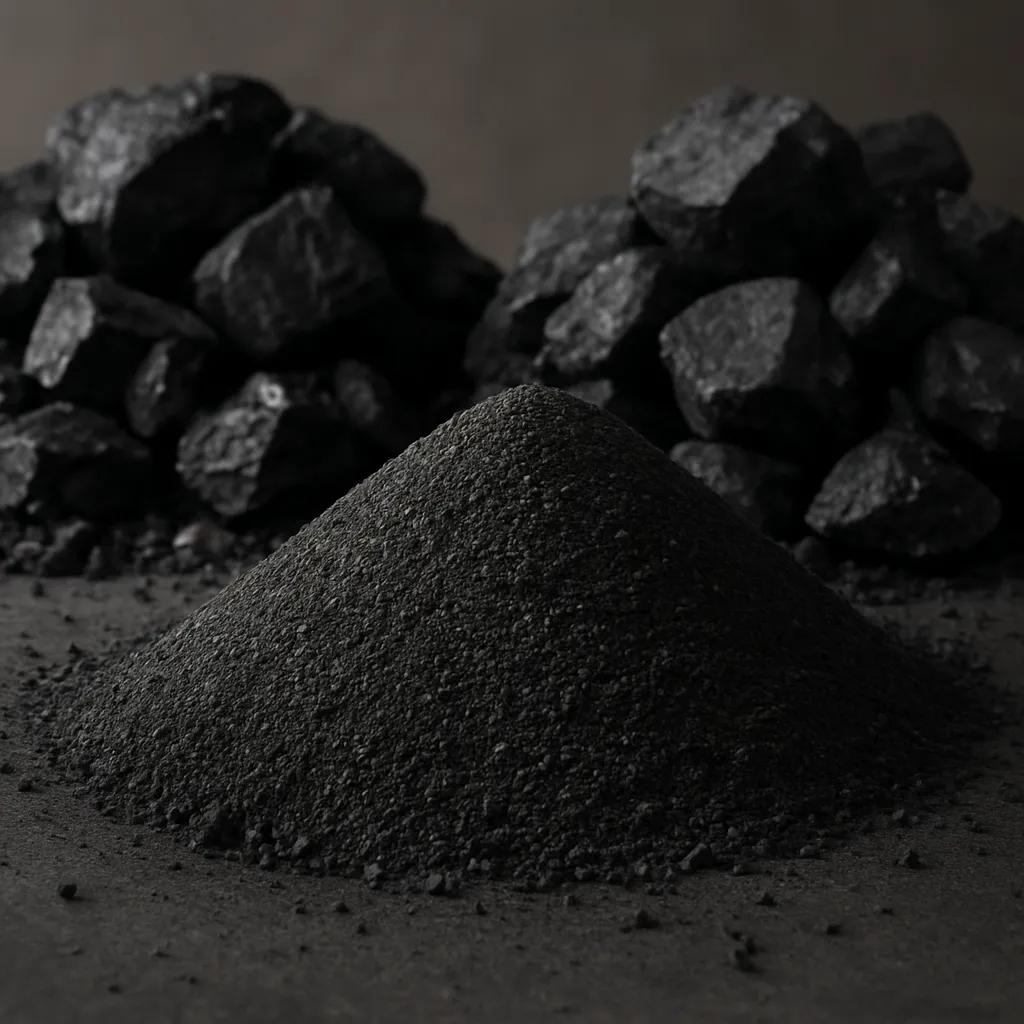
The term recarburizer coal describes high-carbon materials used to increase the carbon content of molten iron and steel during metallurgical processes. Widely used in foundries, steelworks and ferroalloy plants, recarburizers are critical inputs for controlling the microstructure and mechanical properties of cast and wrought ferrous products. This article examines the geological occurrence and mining of recarburizer-grade coals and alternative carbon sources, the industrial roles they play, economic and statistical perspectives, environmental and regulatory considerations, and likely future trends in a decarbonizing world.
Nature, types and physical-chemical properties
In metallurgical usage the generic label recarburizer covers several carbon-rich materials whose primary function is to introduce or restore carbon in molten metal. Typical forms include: high-grade anthracite, furnace or foundry coke, petroleum coke (calcined or uncalcined), graphite and specially manufactured synthetic recarburizers. While the word “coal” is often used colloquially to describe these inputs, technically not all recarburizers are coal-derived; some are refinery by-products or engineered carbon products.
Key desirable properties of recarburizers:
- High fixed carbon content (commonly in the range of 70–95% by weight in effective products).
- Low volatile matter and controlled ash content to minimize slag formation and inclusions.
- Low sulfur and phosphorus to avoid chemical contamination of the steel; sulfur content is often specified below 0.5% and preferably below 0.2% for sensitive applications.
- Good reactivity in the molten bath so that carbon transfers efficiently (factors include particle size, porosity, and chemical form).
- Physical forms adapted to feeding methods: powders, granules, briquettes or pellets, and sometimes paste or wire-feed forms.
From a metallurgical standpoint, the role of a recarburizer is to affect carburization—the controlled addition of carbon that governs phases such as cementite, pearlite and graphite in iron and steel. The choice between anthracite, petroleum coke, graphite or synthetic materials is driven by availability, cost, required carbon activity, and impurity tolerances.
Where it occurs and where it is mined
When “recarburizer coal” refers to natural coal grades used as carbon sources, the most relevant coals are high-rank coals such as anthracite and high-fixed-carbon bituminous coals. These typically form in geological environments where peat deposits have undergone higher degrees of coalification under heat and pressure over geological time.
Major natural sources and mining regions
- China: home to extensive anthracite and high-rank bituminous deposits. China is both a major consumer and producer of carbonaceous materials used in metallurgy, and many Chinese mines produce coal suitable for recarburizer applications.
- Russia and Ukraine: large reserves of high-rank coal and historic metallurgical coke production hubs (e.g., Donbas). Russia is a key supplier of various coal and coke products to nearby steelmaking industries.
- United States: anthracite occurs primarily in eastern Pennsylvania; high-quality metallurgical coals are mined in Appalachia, Illinois Basin and Powder River Basin (though Powder River coals are low rank and less suitable as recarburizers without processing).
- Australia: while best known for metallurgical coking coals in Queensland and New South Wales, Australia also exports carbon products and is a leading supplier of metallurgical-grade coals to Asian steelmakers.
- South Africa, Kazakhstan, Colombia, and Poland: regions with significant coal mining companies supplying both domestic steel industries and export markets.
Beyond natural coal, petroleum coke is produced in oil refining units (delayed coker units) and is widely available from major refining centers in the United States, India, China, Japan and the Middle East. Calcined petroleum coke (CPC) is produced by heating raw petroleum coke to remove volatile hydrocarbons, producing a higher-purity carbon product that is often used where higher reactivity and lower volatiles are required.
Industrial uses and metallurgical significance
The principal industries consuming recarburizers are steelmaking, iron foundries, and specialty ferrous alloy producers. The material is essential wherever the carbon content of molten metal must be adjusted precisely.
Steel and ironmaking processes
- Blast furnace and basic oxygen furnace (BOF)/converter routes: Recarburizers are used in ladle metallurgy after oxygen-blow stages to reintroduce carbon removed during the decarburizing blow. This final carbon adjustment ensures the steel meets composition specifications for subsequent casting and rolling.
- Electric arc furnace (EAF) routes: In EAF steelmaking, recarburizers are often dosed during or after melting to reach target carbon levels—particularly in alloy steels where precise control is necessary.
- Foundries: For cast irons and certain steels, recarburizers control graphite formation and nodularity in ductile iron, and influence hardness and machinability in cast steel products.
- Ferroalloy plants: Carbon is a reducing agent in the production of ferroalloys; high-carbon recarburizers can serve both as reductant and as a source of residual carbon in the final alloy.
Technical considerations in use include dosing methods (powder addition, briquette charging, injection systems), dissolution kinetics (smaller particle sizes dissolve faster but may introduce more dust), and interaction with other alloying elements. For high-performance applications, the presence of impurities like vanadium, nickel, or sulfur in a recarburizer can be critical and often dictates the choice of product.
Economic and trade aspects
The market for recarburizers is tightly linked to the global ferrous metals industry. Because the material is a commodity input to steel and cast metals, its demand closely tracks trends in global steel production and automotive, construction and heavy equipment markets.
Demand drivers and links to global steel production
- Global crude steel production provides the primary demand driver; recent figures place global production at roughly 1.8–1.9 billion tonnes annually (World Steel Association data for the early 2020s). Each tonne of steel requires a small but material amount of carbon input in secondary metallurgy and foundry operations; aggregate demand for recarburizers therefore runs in the tens of millions of tonnes per year when including petroleum coke, anthracite and other carbon products.
- Regional steelmaking patterns determine trade flows: large steel sectors in China, India, Japan, South Korea and the EU create concentrated demand centers for recarburizers.
Major producers, exporters and market structure
- China is both a massive consumer and a large producer of recarburizer-grade coal and petroleum coke, supplying domestic demand and exporting to nearby Asian markets.
- Refinery centers generating petroleum coke (Gulf Coast U.S., Middle East, India) are important sources of coke feedstocks and often export to steelmakers where refinery location does not coincide with metal production.
- Market prices are volatile and depend on crude oil prices (affecting petroleum coke availability), coal supply disruptions, transport costs, and quality differentials (sulfur, ash, fixed carbon).
From an economics perspective, the competitiveness of recarburizer sources depends on: raw material cost, processing (calcination or briquetting), impurity removal or blending costs, and logistics. Because carbon content per tonne and impurity levels vary, buyers often specify product by chemical analysis rather than simple “per tonne” pricing.
Statistical snapshot and notable figures
While precise, up-to-date figures for recarburizer-specific production are distributed across multiple product categories (anthracite coal, petroleum coke, calcined coke, foundry coke), the following contextual statistics help frame the market:
- Global crude steel production in the early 2020s hovered around 1.8–1.9 billion tonnes annually (World Steel Association). Secondary metallurgy additions like recarburizers are indispensable across these tonnes of steel.
- Petroleum coke outputs vary with refinery throughput; countries with large refining industries (U.S., China, India) produce significant quantities of petroleum coke. A share of this—after calcination—serves metallurgical needs.
- Anthracite production and trade remain concentrated in a few countries (China, Russia, Kazakhstan, and to a lesser extent the U.S. and some EU producers), affecting availability for metallurgical uses.
Given the fragmentation of categories (coal vs coke vs calcined coke), many industry buyers and analysts follow tonnage and price indices for “metallurgical coke” and “petroleum coke” as proxies for recarburizer market conditions rather than a single recarburizer commodity index.
Environmental, health and regulatory considerations
Use of coal-based and petroleum-based recarburizers raises several environmental and regulatory issues:
- Emissions: The carbonaceous materials themselves contribute to CO2 emissions when consumed. In some processes, volatile organics and additional pollutants can be emitted during coke or petroleum coke combustion and calcination.
- Impurities and hazardous elements: Certain petcoke and coals contain high sulfur, metals or other elements that can end up in slag, air emissions or waste streams. Managing these requires scrubbing systems and careful material selection.
- Regulatory pressure: As jurisdictions tighten greenhouse gas and airborne pollutant limits, steelmakers and foundries face increasing pressure to reduce their direct carbon footprint and to adopt cleaner or alternative recarburizers where feasible.
Consequently, many metallurgical operations are actively exploring lower-carbon substitutes or process changes: improved scrap utilization in electric arc furnaces (EAF), increased use of direct reduced iron (DRI) with low-carbon reductants, and even novel engineered recarburizers that minimize impurities and improve reaction efficiency. These approaches link industrial carbon management with sustainability goals and regulatory compliance.
Technological innovations and alternatives
Innovation in recarburization focuses on improving carbon transfer efficiency and reducing unwanted impurities and emissions. Notable developments include:
- Synthetic recarburizers produced from high-purity feedstocks or through thermal processing to achieve controlled chemical composition and reactivity.
- Calcined petroleum coke with tailored porosity and reactivity, allowing more predictable dissolution kinetics when added to steel baths.
- Wire and paste feeding systems that enhance safety, reduce dust, and improve dosing precision compared with bulk powder addition.
- Exploratory materials: carbon black, graphite fines and even recycled carbon from spent refractories or dust recovery streams are being assessed as partial substitutes in some contexts.
On the process side, technologies increasing scrap use and electrification (EAFs supplied by renewable electricity) reduce dependence on traditional recarburizers. Yet for many alloys and foundry processes, a controllable, high-purity carbon source remains essential, preserving the market for recarburizer products.
Interesting industry dynamics and case notes
Some observations that illustrate the nuance of the recarburizer market:
- Quality trumps quantity for critical steel applications. A lower-volume, high-purity recarburizer with low sulfur and predictable reactivity can command a premium because it reduces downstream processing costs and scrap rates.
- Logistics and proximity matter. Steelmakers often source recarburizers from regional suppliers to minimize shipping costs and supply disruption risk, creating localized markets within broader global trade flows.
- Refinery economics influence availability. Periods of high crude oil processing can produce abundant petcoke, while refinery slowdowns reduce supply and push buyers toward coal-based options.
- Geopolitical events and trade restrictions can have outsized impacts. Because some recarburizer sources are concentrated geographically, export controls, sanctions or transportation bottlenecks may raise prices rapidly.
Future outlook
The long-term outlook for recarburizer coal and related carbon products is shaped by two competing trends: continuing demand from steelmaking and metallurgical sectors on the one hand, and rising pressure to decarbonize industrial processes on the other. Short- and medium-term demand for recarburizers is expected to remain linked to global steel production volumes, construction cycles and automotive demand. Over the longer term, three dynamics will be especially influential:
- Technological shift toward low-carbon steelmaking: adoption of hydrogen-based reduction, increased EAF scrap usage, and DRI routes could reduce traditional recarburizer demand.
- Material substitution and recycling: development of high-efficiency synthetic recarburizers, improved dust recovery and recycling of process carbon streams could change product mixes.
- Regulatory and market pricing of carbon: stronger carbon pricing or stricter emissions limits will incentivize lower-carbon inputs and possibly accelerate investment in alternative recarburization technologies.
In parallel, the fundamental metallurgical necessity of precise carbon control in many ferrous products suggests that a market for specialized, high-quality recarburizers will persist even as bulk, lower-grade carbon sources decline in importance.
Summary
Recarburizer coal and related carbon products play a central but often underappreciated role in modern metallurgy. Whether derived from anthracite, petroleum coke, coke, graphite or engineered materials, recarburizers enable critical final adjustments to the carbon content that determine the performance of steel and cast irons. The market is shaped by global steel output (around 1.8–1.9 billion tonnes annually in the early 2020s), regional production and refinery dynamics, and ongoing shifts toward lower-emission industrial processes. From geology and mining through logistics and environmental regulation, recarburizers sit at the intersection of metallurgy, commerce and sustainability—making their supply, quality and evolving alternatives subjects of sustained interest for industry, policymakers and researchers alike.