Shallow-mine coal — coal extracted from deposits close to the surface — plays a major but sometimes overlooked role in the global fossil-fuel economy. This article examines where such coal is found and how it is mined, its economic and industrial importance, statistical perspectives and trends, environmental and social impacts, and several technical and historical curiosities connected with shallow deposits. The text aims to give a rounded picture of shallow-mine coal for planners, students and anyone interested in energy and raw-material geography.
Definition, types and mining methods
Shallow-mine coal generally refers to coal deposits that occur at relatively small depth beneath the surface and are therefore accessible by surface or near-surface mining methods. Depending on geology, a coal seam may be classified as suitable for opencast or strip mining, highwall mining, auger and trench methods, or shallow underground workings such as adits, drift mines and room-and-pillar operations. The classification is pragmatic: if overburden thickness is low enough to make stripping economical, the deposit is treated as a shallow amenity.
Common methods used on shallow seams
- Open-pit/opencast mining (also called opencut or surface mining) — removal of overburden using draglines, excavators and trucks.
- Strip mining — long, narrow strips of overburden removed along the strike of the seam; widely used for relatively flat-lying seams.
- Highwall mining — mechanized extraction from the exposed face of a recently strip-mined area, useful where continuous open-pit removal becomes uneconomic.
- Auger mining — drilling and cutting into the seam from the highwall to recover coal otherwise left behind after conventional stripping.
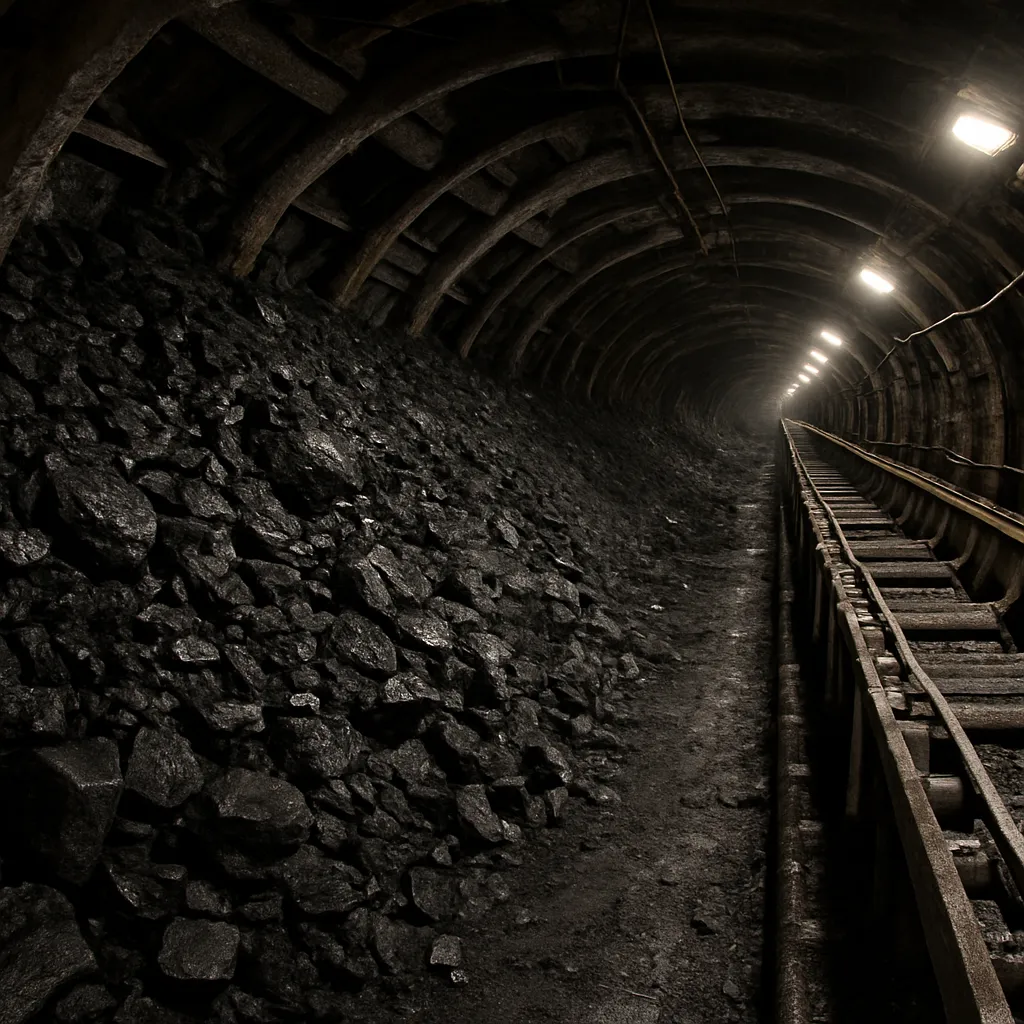
- Shallow underground (drift or adit) mines — used where seams outcrop on slopes or are protected by a thin caprock.
Each method balances capital cost, unit operating cost, environmental footprint and safety. In many regions, opencast and strip mining are favored for economy of scale and lower operating costs per tonne compared with deep underground mining.
Geographical distribution and key producing regions
Shallow coal occurrences are widely distributed because many economically important coal deposits were formed in ancient coastal swamps and river deltas, which later became buried under relatively thin sediments. As a result, shallow seams are common in large basins around the world. Some notable regions and examples:
Europe
- Germany — large lignite (brown coal) open-cast mines in the Rhenish and Lusatian basins (Garzweiler, Hambach, Jänschwalde) are classic shallow mining operations that feed local power plants.
- Poland — extensive lignite surface mines (e.g., Bełchatów, the largest open-cast mine in Europe by output) and numerous smaller shallow deposits support domestic power generation and industry.
- United Kingdom — while much of the UK’s historic coal was mined underground, some younger or outcropping seams were exploited by surface methods, and coastal/estuarine seams in England and Wales produced shallow coal historically.
North America
- United States — the Powder River Basin (Wyoming, Montana) is dominated by large open-pit mines producing low-sulfur subbituminous coal; the Illinois Basin and Western Kentucky have many shallow seams mined by strip methods; Appalachian regions have both shallow and deep workings.
- Canada — open-pit mining for thermal coal occurs in parts of Alberta and British Columbia where seams are near surface.
Asia and Oceania
- China — extensive shallow and mid-depth seams across many basins; China’s massive coal production includes significant surface mining operations, particularly for thermal coal used in power plants.
- India — large shallow seams of lignite and some coal in states such as Tamil Nadu and parts of the eastern coalfields; however, many Indian coal deposits are mined by underground methods as well.
- Australia — Queensland and New South Wales feature large open-cut operations; many of Australia’s thermal and metallurgical coals are mined by surface methods where geology allows.
Economic and industrial significance
Shallow-mine coal has several distinguishing economic characteristics. Because of easier access and simpler mining logistics, surface and shallow operations typically have lower unit extraction costs and higher productivity than deep underground mines. This has implications for regional economies, energy markets and industrial supply chains.
Cost structure and competitiveness
- Lower operating cost per tonne: Bulk removal by draglines and continuous machinery enables low marginal cost of production when seam thickness and stripping ratios are favorable.
- Capital intensity: Large surface mining equipment and processing infrastructure require significant upfront investment; however, payback periods are often short when markets are strong.
- Transportation and logistics: Proximity to railways, rivers or ports is crucial. Many shallow-mined coals are used to supply nearby power stations to reduce transport cost.
Shallow-mine coal is therefore often the backbone of local energy security and industrial clusters. Large power stations co-located with open-cast mines are a common pattern in Europe and Asia, minimizing logistics and enabling baseload supply.
Employment and regional economics
Surface mines typically employ fewer workers per tonne produced compared with underground mines, because mechanization reduces labor intensity. This means shallow coal operations can generate significant economic output with modest employment levels relative to production. The consequence is mixed: efficient production and lower electricity prices on one hand, and fewer direct mine jobs on the other. Indirect employment in logistics, equipment maintenance and local services remains important.
Statistical perspectives and trends
Quantifying the role of shallow mining requires looking at overall coal production patterns, regional profiles and trends in mining technology and energy demand.
Production shares and regional figures (generalized)
- Global coal production is concentrated in a handful of countries — historically including China, India, the United States, Indonesia, Australia and Russia — and a substantial portion of that production is from surface and shallow operations where geology permits.
- In countries like the United States and Australia, surface mining accounts for a significant share of total coal production because major basins have large shallow seams; some basins contribute a large fraction of national output (for example, the Powder River Basin in the U.S. has been responsible for a very large share of American coal production in recent decades).
- In Europe, countries with abundant lignite deposits (Germany, Poland, Czechia) rely heavily on surface mining for domestic power generation; single mines in these regions can produce tens of millions of tonnes annually.
Exact percentages of global coal produced by surface methods vary by source and year, but surface mining is widely recognized as a major component of global coal supply, especially for thermal coal used by power plants.
Market trends
Recent years have seen important shifts affecting shallow coal markets:
- Declining demand in parts of Europe and North America as power systems decarbonize, resulting in reduced life or closure of some shallow coal operations.
- Strong or sustained demand in parts of Asia and for export-oriented producers, supporting continued operation and even expansion of open-cut mines.
- Improvements in mining efficiency and automation, which reduce unit labor costs but raise capital intensity and require different community adaptation strategies.
Environmental, social and regulatory issues
Shallow mining has an outsized visible environmental footprint relative to some underground methods. The effects include land disturbance, ecosystem disruption, water impacts and greenhouse-gas emissions. Governments and companies increasingly respond with regulatory frameworks and reclamation obligations to limit long-term damage.
Land disturbance and reclamation
Open-cast and strip mines remove vegetation and topsoil over broad areas. Modern regulations often require progressive reclamation — restoring topography, replacing soil and replanting — with varied success. Reclaimed sites have been converted into agricultural land, urban developments, recreational lakes and wildlife habitats in many countries.
Water and air impacts
- Sediment and runoff from disturbed areas can affect local streams and groundwater.
- Dust and particulate emissions may reduce local air quality unless mitigated by water spraying and enclosures.
- Methane release: shallow seams and disturbed strata can emit methane; capture for power or flaring reduces atmospheric emissions and can provide local energy.
Carbon and climate considerations
Coal combustion is a major source of CO2 emissions. Although shallow coal production often targets lower-rank thermal coal used for electricity, the climate impacts of combustion do not disappear because of surface extraction. Policymakers weigh the short-term economic value of these resources against long-term climate targets, shaping investment and closure schedules.
Social and cultural impacts
Large surface mines can displace communities, alter landscapes with cultural significance, and trigger legal and political disputes. Conversely, they can also deliver infrastructure, revenue and local employment. Transparent planning, stakeholder engagement and fair compensation are crucial in managing these trade-offs.
Technical innovations and future directions
Technological advances influence the cost-efficiency, environmental footprint and safety of shallow-mine coal operations. Important developments include:
- Automation and remote operation of draglines, shovels and haul trucks, improving safety and lowering labor needs.
- Highwall mining units that extend recovery beyond what is practical with conventional stripping, increasing resource recovery with reduced surface impact.
- Advanced geological modeling and remote sensing to optimize strip ratios and reduce waste stripping.
- Rehabilitation technologies: soil amendments, phytoremediation and controlled recontouring to accelerate ecosystem recovery.
- Integration with carbon-management strategies such as co-located carbon capture at power plants fed by mine-mouth coal, though CCS adoption is still limited by cost.
Case studies and notable examples
Several mines and regions illustrate the variety and scale of shallow-mine coal operations:
Bełchatów (Poland)
Bełchatów is one of Europe’s largest open-cast lignite mines, routinely producing tens of millions of tonnes annually to feed the adjacent power station. The mine supplies a substantial portion of Poland’s electricity, demonstrating the common pairing of shallow mine and nearby thermal generation plant that minimizes transport costs and supports energy security.
Powder River Basin (United States)
The Powder River Basin in Wyoming and Montana hosts very large, low-sulfur subbituminous coal seams that are mined in vast opencast operations. Historically this basin supplied a very large share of U.S. coal, especially for pulverized-coal power plants across the country. The combination of shallow seams and thick, laterally continuous coal makes it an archetype of large-scale shallow mining.
Rhenish Lignite (Germany)
Rhenish lignite mines, including Hambach and Garzweiler, are expansive shallow operations that have shaped regional land-use and energy policy. Their existence has prompted major debates in Germany on energy transition, land-use planning and the pace of coal phase-out.
Interesting scientific and historical notes
Coal seams exposed or near the surface have contributed to scientific and cultural knowledge:
- Fossils and paleoenvironmental records: shallow seams and associated layers can preserve plant fossils and other indicators that help reconstruct prehistoric climates and ecosystems.
- Coal seam fires: shallow coal is more prone to natural and anthropogenic combustion (e.g., Centralia, USA; Jharia, India), leading to long-lasting fires that burn for decades and complicate reclamation.
- Coal-bed methane (CBM): shallow seams can be sources of fugitive methane which, when captured, provide a supplemental energy source and lower greenhouse-gas emissions compared with uncontrolled release.
Outlook: economics, policy and transition
The future of shallow-mine coal is intertwined with broader energy transitions. While demand for coal is declining in some advanced economies due to emissions policies and competition from gas and renewables, demand persists in many regions for either economic or reliability reasons. Some likely developments:
- Gradual decline in coal use in power systems that aggressively decarbonize, prompting mine closures and redevelopment of former sites.
- Continued production in regions with growing electricity demand or where coal is economically favored for industrial feedstock.
- Increased emphasis on responsible closure, social support for displaced workers, and repurposing of mine sites for renewable energy, pumped-storage, recreation or agriculture.
- Policy-driven reductions in emissions from shallow-coal use, including methane abatement, improved efficiency and selective use of CCS where economically feasible.
Shallow-mine coal remains a material of great importance where it exists — delivering affordable energy and raw material for industry, but also posing environmental and social challenges that require careful governance. Understanding where shallow coal occurs, how it is mined, and the economic and regulatory contexts that shape its use is essential for balanced decision-making about energy, land use and regional development.