The New Largo Mine, located in South Africa’s prolific coal-producing region, represents a modern example of the country’s long-standing reliance on coal as a cornerstone of energy and industrial activity. This article examines the mine’s location, the type of coal extracted, the geology and mining methods, economic and social impacts, environmental considerations, and its wider significance within the South African and regional coal industries. It aims to provide a comprehensive, balanced overview, combining operational, statistical and contextual information relevant to industry stakeholders, policy makers and the general public.
Overview and location
New Largo is situated in the Highveld coalfields of the Mpumalanga province, an area that forms the heart of South Africa’s coal production. The Highveld region stretches across a broad swathe of central-eastern South Africa and contains many of the country’s largest and oldest coal operations. The mine lies within the general footprint of this coal belt, close to transport infrastructure that links coal-producing areas with domestic power stations and export terminals on the east coast.
The mine’s strategic location ensures proximity to major industrial consumers, particularly South Africa’s dominant state-owned power utility, Eskom, and to rail lines that feed the export gateways such as the Richards Bay Coal Terminal. Accessibility to these logistical networks is a critical factor that determines the commercial viability of coal projects in the region, allowing New Largo to serve both domestic energy markets and, where permitted, export markets.
Geology and coal characteristics
The coal seams exploited at New Largo occur in sedimentary basins typical of the Mpumalanga Highveld. These seams are part of a sequence deposited during the Permian period and are known for their lateral continuity and relatively uniform quality compared with many other coal-bearing regions worldwide.
Type of coal
The primary product from New Largo is thermal coal, generally with properties characteristic of the regional product: bituminous rank with moderate to high calorific values suitable for power generation. Typical parameters for Highveld thermal coal that are often similar to New Largo’s product include:
- Calorific value in the range of approximately 18–28 MJ/kg (on an as-received or air-dried basis, depending on seam and washing).
- Moderate ash content, variable between seams and influenced by beneficiation.
- Sulfur content that is generally low to moderate, although precise values depend on the seam and depth.
- Volatile matter and moisture contents consistent with mid- to high-volatile bituminous coal.
In many cases, coal mined in Mpumalanga can be beneficiated (washed) to improve calorific value and reduce ash and sulfur levels, making the product more competitive as a fuel for modern power plants and, in some instances, suitable as a blend component for higher-specification requirements.
Mining methods and operational aspects
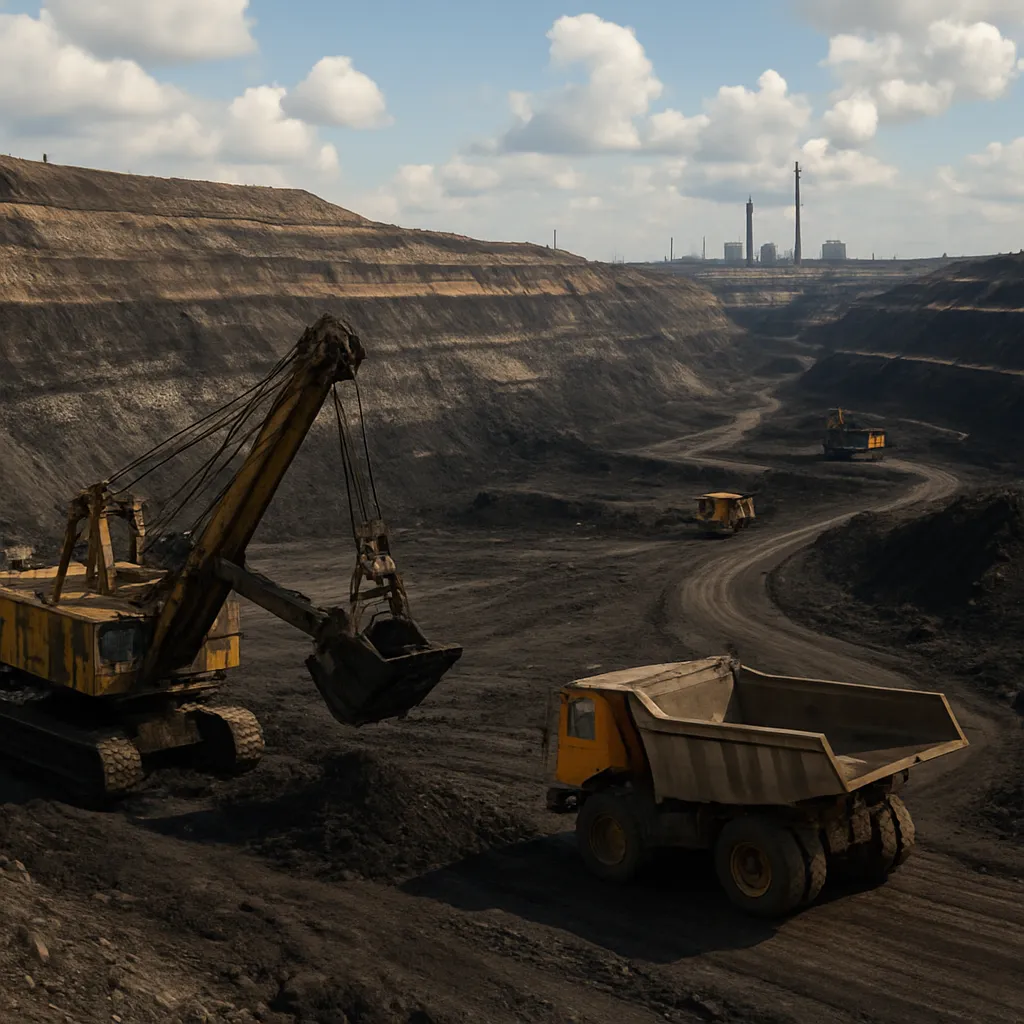
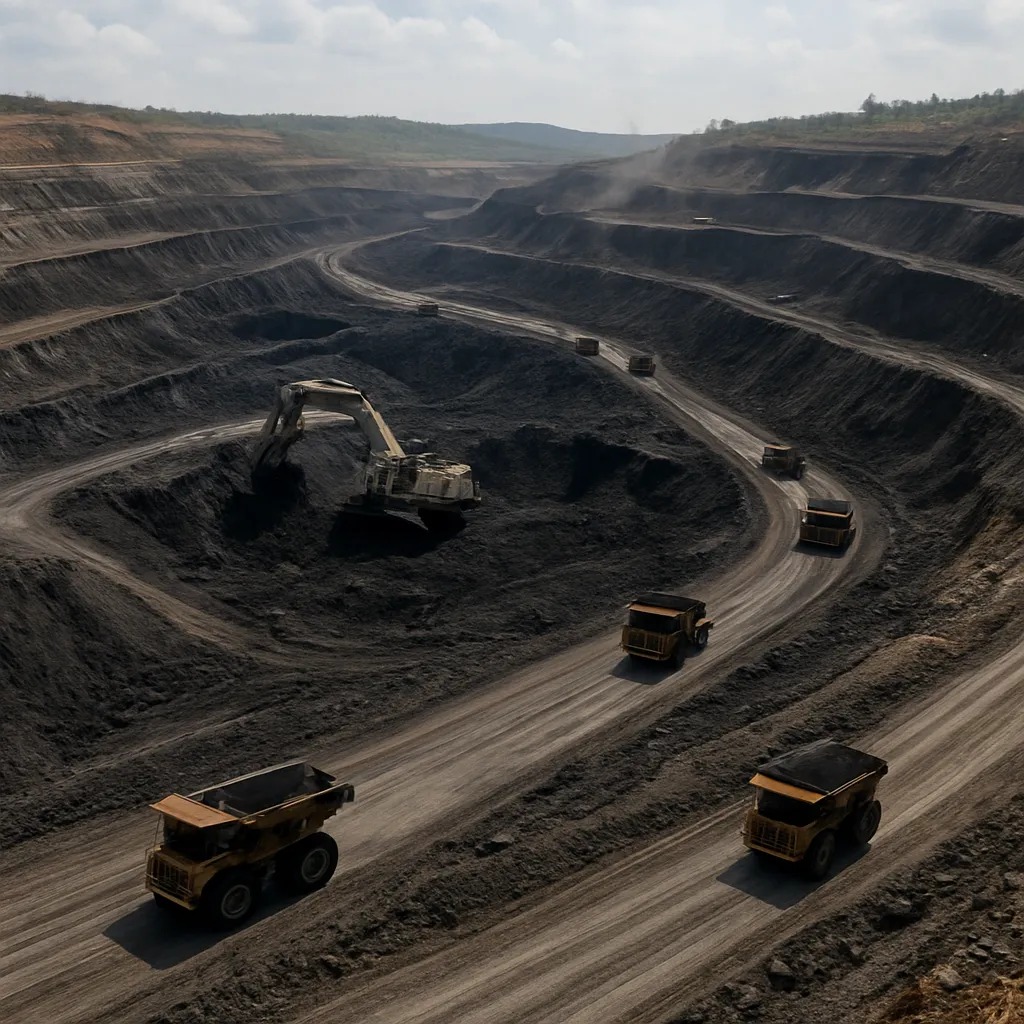
Operations at New Largo typically employ either surface (open-pit) or a combination of surface and near-surface underground methods, depending on seam depth and local topography. In the Mpumalanga Highveld, opencast mining is common where seams are shallow and lateral continuity enables efficient removal of overburden.
Modern operations emphasize mechanization, conveyor systems for material handling, and on-site coal processing (screening and washing) to produce marketable products. The mine’s logistics include internal haulage roads, rail access points, water management infrastructure and dedicated stockyard and loading facilities. Health and safety, as well as continuous equipment maintenance, are central to daily operations, reflecting both regulatory requirements and industry best practices.
Beneficiation and product streams
Coal washing plants associated with mines like New Largo are used to produce multiple product streams: a higher-grade thermal product for power stations and export, middlings used for local industrial consumers, and rejects which are managed under strict environmental controls. Beneficiation improves the marketability of coal and reduces the environmental footprint of combustion by lowering ash and sulfur delivered to the customer.
Economic and social impacts
Coal mining projects in Mpumalanga, including New Largo, generate significant local economic activity. The main areas of economic contribution include employment, local procurement, royalties and taxes, and investment in community development programs.
- Employment: Mines of this scale typically provide direct employment for several hundred to a few thousand workers, depending on the mine’s production rate, level of mechanization and stage of operation. Indirect employment in service industries, logistics and supply chains multiplies the broader employment effect.
- Local economy: Procurement of goods and services—ranging from fuel and equipment to catering and maintenance—supports local businesses and municipal revenues. Community investment and social labour plans are often negotiated as part of mining rights and licensing.
- Government revenue: Royalties, corporate taxes and employment taxes contribute to provincial and national budgets. In addition, infrastructure investments such as road upgrades or power connections undertaken by mining companies can have economic multipliers.
The socioeconomic footprint of New Largo extends to training and skills development programs, which are frequently part of mining company commitments to enhance local workforce readiness and to meet regulatory social and labour plan obligations.
Statistical picture and production
While specific annual production figures for any individual mine such as New Largo vary by year, size and the maturity of operations, the regional and national context provides a clear backdrop:
- National production: South Africa’s total coal production generally falls in the range of roughly 200–260 million tonnes per year (depending on market conditions and reporting year), with the Mpumalanga province producing the majority—often quoted as around 70–80% of national output—because of the Highveld coalfields.
- Export market: A significant fraction of South African coal is exported via east-coast ports, especially to Asian markets. Domestic consumption—driven primarily by Eskom power stations—also absorbs a large share of production.
- Mine-scale indicators: Medium-scale mines in the region commonly produce between 1 and 5 million tonnes per annum. Larger complexes produce tens of millions of tonnes annually. Reserves supporting long-term operation vary from tens to hundreds of millions of tonnes depending on the concession area and seam continuity.
New Largo’s relative significance is determined by its annual production capacity, reserve base and the quality of product it supplies to domestic utilities or export markets. Even a mine producing a few million tonnes a year can play a critical role in local employment and supply chains.
Significance in the industry and market linkages
New Largo contributes to several key industry functions:
- Supplying domestic power generation demand, where coal-fired generation remains a primary source of baseload electricity.
- Supporting export earnings when products meet international specifications and logistical arrangements allow shipment to overseas buyers.
- Acting as a regional economic anchor through employment and procurement.
The mine’s product quality and reliability of supply are important for both domestic utilities and international buyers who require consistent calorific value and predictable ash and moisture characteristics. Where New Largo coal is blended, it can be used to manage combustion characteristics in large thermal plants and to meet contractual quality clauses for exports.
Environmental management and regulatory context
Coal mining is subject to stringent regulatory frameworks in South Africa that address environmental impact assessment, water use licensing, atmospheric emissions, waste management and mine closure planning. New Largo, like all contemporary mines, is required to develop and implement:
- Comprehensive environmental management plans covering land disturbance, dust suppression, noise control and biodiversity protection.
- Water management systems to control runoff, manage contaminated water, and comply with the National Water Act and related regulations.
- Air quality monitoring and mitigation measures to limit particulate and gaseous emissions affecting local communities.
- Progressive rehabilitation and final mine closure plans that restore land use where possible and minimize long-term environmental liabilities.
Greenhouse gas emissions are a key component of the wider debate surrounding coal. Coal combustion for electricity produces roughly 2 to 3 tonnes of CO2 per tonne of coal burned (depending on coal quality and combustion efficiency), and these emissions are increasingly factored into national energy planning, carbon budgeting and investor decision-making. Mines and utilities are exploring options such as improved efficiency, co-firing with lower-emission fuels, methane capture and participation in carbon markets where available.
Community relations and social governance
Community engagement is a central part of the social license to operate. New Largo typically engages with local stakeholders to resolve land access issues, manage workforce recruitment, implement social and labour plans and fund local development initiatives. Common elements include:
- Skills training and apprenticeship programs to improve employability.
- Local enterprise development to foster suppliers and contractors from adjacent communities.
- Public health, water supply and education projects negotiated as part of mining development agreements.
Transparent grievance mechanisms and regular stakeholder consultations help to mitigate tensions associated with land use change, labour practices and environmental impacts.
Risks, challenges and future outlook
New Largo operates in a complex environment shaped by market dynamics, regulatory pressures and community expectations. Key challenges include:
- Market uncertainty: Volatility in international coal prices and domestic electricity demand can affect revenue streams and investment planning.
- Policy dynamics: National energy policy decisions—such as timelines for decommissioning coal-fired power plants or adopting renewables—can alter long-term coal demand projections.
- Environmental and social expectations: Increasing scrutiny from financiers, consumers and regulators demands higher performance on emissions, rehabilitation and social responsibility.
However, in the short to medium term, coal remains a major component of South Africa’s energy mix. Mines like New Largo are therefore likely to continue playing a role in securing baseload supply, while adapting to new standards for environmental management and social governance. Investment in beneficiation, efficiency upgrades and responsible closure planning will shape long-term viability.
Concluding remarks
New Largo exemplifies a contemporary coal mining operation in South Africa’s Highveld region: positioned strategically within a major coal province, producing primarily thermal coal for domestic and possibly export markets, and subject to a complex mix of economic, environmental and social obligations. The mine contributes to regional employment and revenue, but also faces the challenges associated with a global energy transition and heightened expectations for environmental performance. Its continued role will depend on operational efficiency, market conditions and the ability to meet increasingly stringent sustainability requirements.
Key terms highlighted: New Largo, Mpumalanga, coal, thermal coal, bituminous, production, employment, exports, Eskom, rehabilitation.