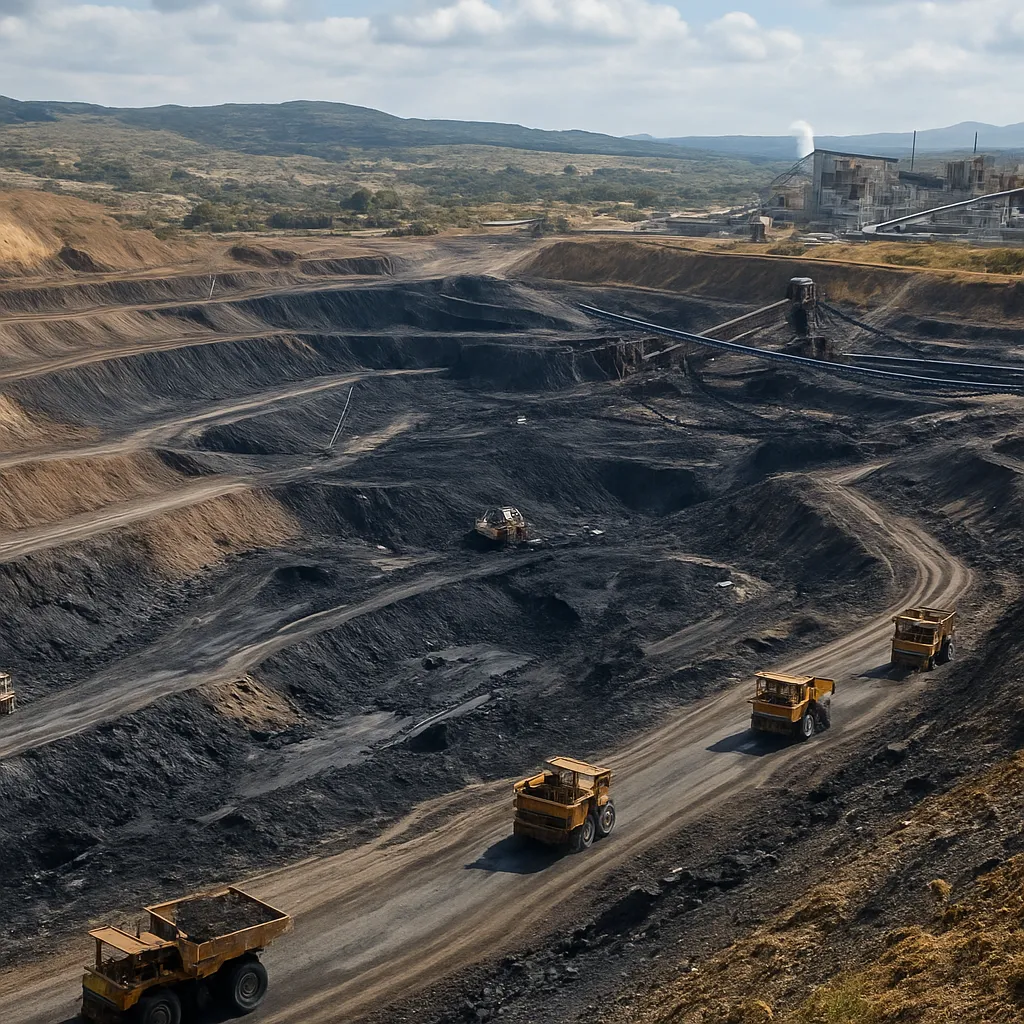
Rix’s Creek Mine is a prominent coal operation located in the Hunter Valley region of New South Wales, Australia. This article provides a comprehensive overview of the mine’s location, geology, the types of coal produced, operational history, economic and statistical data where available, environmental and community impacts, and its role within the regional and global coal industry.
Location and regional context
Rix’s Creek Mine is situated near the town of Singleton in the Hunter Valley, one of Australia’s most important coal-producing regions. The Hunter Valley lies approximately 200 kilometers north of Sydney and hosts numerous coal mines and rail and port infrastructure that serve both domestic power generation and international export markets. The mine itself is part of a cluster of operations that benefit from proximity to the Port of Newcastle, the world’s largest coal export port, enabling efficient shipping to major Asian markets.
Geographic setting
The mine sits in a landscape dominated by rolling agricultural land, mining infrastructure and native vegetation corridors. Transportation links—rail, roads and coal terminals—are well established in the region. The Hunter Valley’s geology and long history of coal mining have led to a dense concentration of mining permits and operational sites, with Rix’s Creek forming a component of that wider industrial network.
Ownership, history and operation
Rix’s Creek has been developed and operated under several ownership arrangements over the decades. The operation came under the umbrella of major coal companies, and in recent years it has been associated with large multinational miners. The mine has comprised both open-cut and underground workings at different times, reflecting the multi-seam nature of the coal-bearing sequences in the Hunter Basin.
Historical development
- Early exploration and small-scale mining in the region date back to the 19th and early 20th centuries as the Hunter coalfields were developed.
- Large-scale mechanized operations expanded in the later 20th century; Rix’s Creek developed as part of this trend, moving from smaller pits to more integrated operations.
- Ownership consolidation over recent decades placed many Hunter Valley assets under the control of major global miners, streamlining logistics and marketing into export channels.
Geology and coal types
The Hunter Basin hosts Permian-age coal measures. Rix’s Creek taps into these stratigraphic sequences, producing coal that is predominantly thermal coal (steam coal) used for electricity generation. In some instances, quality variations in the seams may allow coal from the mine to be blended or upgraded for higher-value uses, though the primary product has historically been thermal-grade bituminous coal.
Coal quality characteristics
- Rank: Typically bituminous, within thermal coal specifications.
- Calorific value: Variable across seams; Hunter Valley thermal coals generally have moderate to high energy content suitable for export to Asian power stations.
- Ash and sulfur: These properties vary; operators apply washing and beneficiation to reduce ash content and meet buyer specifications.
- Blend potential: Coal can be blended to meet different calorific or emission requirements for clients, particularly in export markets.
Production, processing and logistics
Rix’s Creek has historically produced several million tonnes of coal per year. Precise annual figures have varied with market demand, mining method (open-cut versus underground) and regulatory conditions. Production is generally complemented by on-site processing including coal handling and preparation plants (CHPP) where coal is washed and sized to meet contractual quality specifications.
Processing
Typical processing at a mine like Rix’s Creek includes:
- Primary crushing and screening;
- Washing and density separation to reduce impurities and lower ash content;
- Stockpiling and reclaim systems to manage product to contract;
- Loading onto rail for export or domestic dispatch.
Transport and export
Coal from Rix’s Creek is transported by rail to export terminals—primarily the Port of Newcastle—where it is shipped to international markets in Asia (Japan, South Korea, China, Taiwan, India, among others). Robust rail connectivity and export capacity in Newcastle have been central to the mine’s commercial viability. Domestic supply to Australian power stations and industrial consumers can also form part of the sales mix depending on market conditions.
Economic and statistical information
Rix’s Creek contributes to both the local and national economy through direct employment, royalties, taxes and the stimulation of regional supply chains. While exact statistics can change year to year, some consistent themes illustrate the mine’s economic footprint.
Production and reserves (general estimates)
Historical production rates for mines of this type in the Hunter Valley frequently range from a few million tonnes to several million tonnes per annum. Reserves and resource estimates for individual operations typically run into tens of millions of tonnes of mineable coal, though those figures depend on the mine plan, permissible extraction areas and economic cutoffs. Many Hunter Valley operations report planned mine lives measured in decades when combined proven and probable reserves are accounted for.
Employment and local economic impact
- Direct employment: A typical medium-to-large operation in the Hunter region employs several hundred workers onsite across mining, processing, maintenance and management roles.
- Indirect employment: Contractors, suppliers and local service industries significantly expand the employment footprint—often several times the direct workforce.
- Regional revenue: Royalties, wages and local procurement generate economic activity in towns such as Singleton and surrounding local government areas.
Revenue, export value and market role
Coal exports from the Hunter Valley contribute billions of Australian dollars in export revenue annually across the region’s combined operations. The value attributable to a single mine varies with production volume, coal quality and global price cycles. Rix’s Creek, as part of a larger portfolio, contributes to corporate revenues and to Australia’s position as a leading thermal coal exporter.
Regulatory, environmental and community considerations
Coal mining in the Hunter Valley operates within a framework of state and federal regulation covering environmental management, rehabilitation, biodiversity offsets, water use and air quality. Rix’s Creek has been subject to these regulatory requirements and to community consultation processes regarding noise, dust, traffic and land rehabilitation.
Environmental management
- Water: Mines manage water through licensed extraction, sediment controls, water treatment and recycling within site water management systems.
- Air quality: Dust suppression, progressive rehabilitation and operational controls mitigate particulate emissions.
- Biodiversity: Where mining affects native vegetation or habitats, offset programs and rehabilitation plans are implemented to meet approval conditions.
- Rehabilitation: Progressive land rehabilitation aims to restore landforms, soils and vegetation, with tailoring for future pastoral, conservation or other land uses.
Community engagement
Operations like Rix’s Creek invest in local programs, infrastructure contributions and consultation mechanisms to maintain social license to operate. Community concerns often focus on noise, dust, road safety and impacts on agricultural land values. Effective engagement and transparent reporting help address these issues.
Safety, technology and operational practices
Safety is central to modern mining practice. Underground workings, in particular, require rigorous standards for ventilation, ground control and emergency preparedness, while open-cut operations concentrate on slope stability, haul road safety and machinery maintenance. Technological advances—automation, remote monitoring, and improved CHPP processes—have enhanced efficiency and safety in many Hunter Valley operations.
Innovation and efficiency
- Automation: Use of remotely controlled equipment reduces personnel exposure to hazardous tasks.
- Data analytics: Fleet management and predictive maintenance improve uptime and reduce costs.
- Processing improvements: Advanced washing and dewatering reduce transport costs and improve product quality.
Significance in industry and wider markets
Rix’s Creek contributes to Australia’s role as a major global coal supplier. Despite long-term structural pressures on thermal coal demand in some markets due to climate change mitigation and energy transitions, several key points underscore the mine’s significance:
- Market supply: The Hunter Valley remains a core source of coal for energy markets across the Asia–Pacific.
- Regional cluster effect: The concentration of mines, rail and port infrastructure in the Hunter Valley boosts efficiency and lowers per-tonne logistics costs.
- Employment and regional development: The mine supports local economies, schools, and regional services through payrolls and corporate community programs.
Challenges and future outlook
Like many coal operations, Rix’s Creek faces a set of challenges and opportunities shaping its medium-term outlook:
Market dynamics
Global demand for thermal coal fluctuates with energy cycles, policy shifts and competition from alternative fuels. Asian markets continue to be important buyers, but demand elasticity matters—prices and contract availability influence mine planning.
Regulatory and social license pressures
Emissions targets, planning approvals, and community expectations are increasing the emphasis on environmental performance, rehabilitation commitments and transparent reporting. Mines must navigate evolving regulations related to water management, greenhouse gas emissions and local amenity impacts.
Transition and diversification
Operators are exploring ways to diversify energy portfolios, improve the carbon efficiency of coal supply chains, and pursue land-use transitions post-mining. Options include rehabilitation for conservation or agriculture, and exploring CCS (carbon capture and storage) or co-firing blends in marketable coal products where feasible.
Interesting facts and notable aspects
- Strategic location: Situated within the Hunter Valley, Rix’s Creek benefits from an integrated logistics chain to the Port of Newcastle.
- Multiple mining methods: The site historically encompassed both open-cut and underground operations, reflecting the vertical extent of coal seams.
- Local partnerships: Mines in the region often collaborate with universities, research institutions and service providers to trial new technologies.
- Rehabilitation focus: Progressive rehabilitation is a regulatory and corporate priority, aiming to leave post-mining land in a safe and productive condition.
Summary and concluding remarks
Rix’s Creek Mine is a significant component of the Hunter Valley coal industry, producing primarily thermal coal and leveraging well-developed infrastructure to supply domestic and international markets. The mine supports the local economy through employment, royalties and procurement while operating under a framework of environmental regulation and community engagement. Its ongoing relevance depends on market conditions, regulatory environments, and the mine operator’s ability to manage environmental and social impacts while maintaining safe and efficient operations.
Overall, Rix’s Creek demonstrates many of the defining features of modern Australian coal mining: integration into a regional supply chain, application of evolving technology and environmental practices, and a continuing role in energy and export markets even as the industry navigates a period of transition.