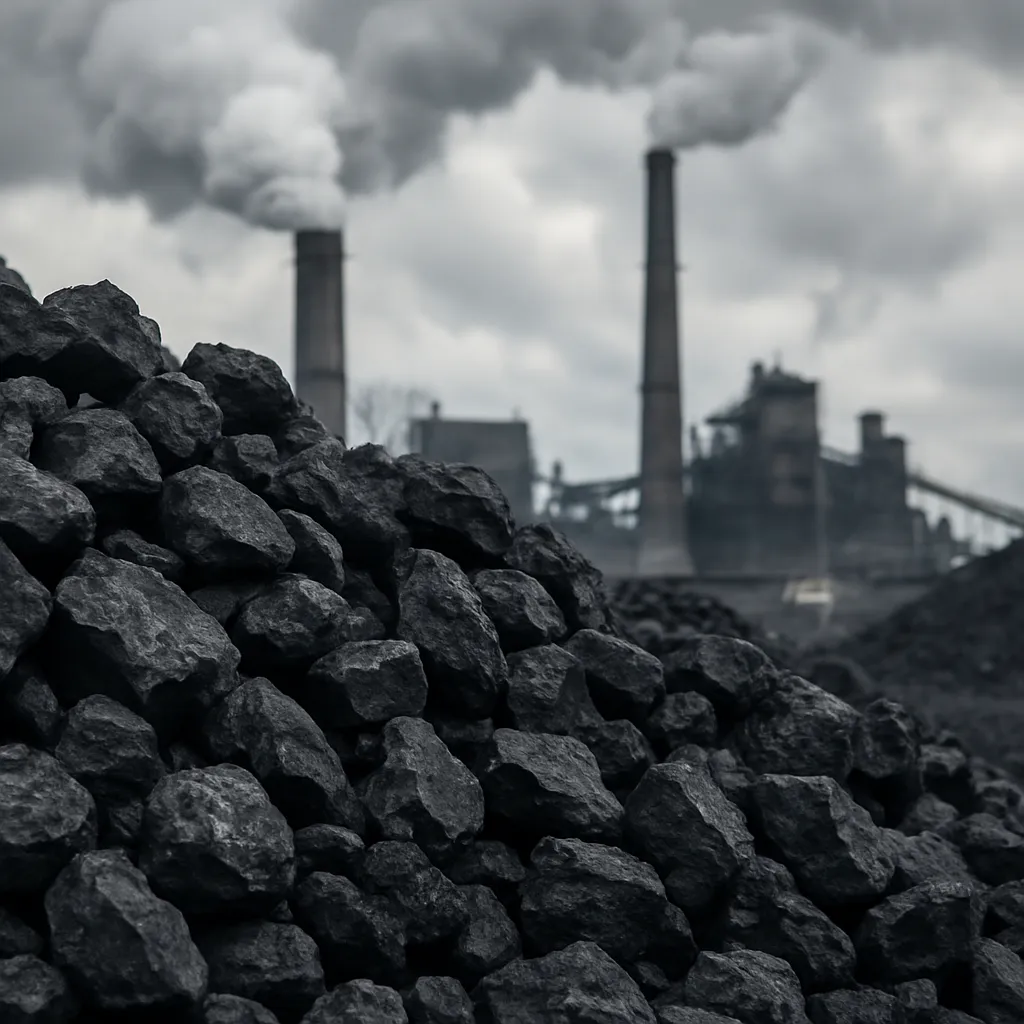
The following article explores utility steam coal — the thermal coal used predominantly for producing heat and electricity — examining its geological occurrence, global mining hotspots, economic and statistical context, industrial importance, environmental challenges and technological responses. Steam coal remains a central fuel for many power systems worldwide, even as energy transitions accelerate. This text offers technical descriptions, market data trends, and practical insights into logistics, quality parameters and future prospects.
What is utility steam coal?
Utility steam coal, often simply called steam coal or thermal coal, is the grade of coal principally used in boilers and power stations to generate power generation and heat. It is distinct from metallurgical (or coking) coal, which is used in steelmaking. Steam coals range in rank from lignite and sub-bituminous, through bituminous ranks; their suitability depends on attributes such as calorific value (energy content), moisture, ash yield, sulphur and volatile matter.
Key physical and chemical properties
- Calorific value: commonly expressed in MJ/kg or kcal/kg. Typical ranges: lignite ~8–20 MJ/kg, sub-bituminous ~17–24 MJ/kg, bituminous ~24–32+ MJ/kg.
- Moisture: higher in lignite and some sub-bituminous coals, reducing effective energy density.
- Ash content: determines the amount of residue after combustion and affects handling and disposal costs; export steam coals are often washed to reduce ash.
- Sulfur: influences SOx emissions; low-sulfur (<1% or lower) coals are preferred in regions with strict air quality rules.
- Volatile matter: affects combustion behavior and boiler design.
Where steam coal occurs and where it is mined
Coal deposits are sedimentary and occur in many parts of the world, primarily in basins that accumulated organic material during the Carboniferous and later geological periods. Coal reserves are geographically concentrated but widespread enough to support large national industries.
Major producing countries
- China: the largest producer and consumer of coal, with extensive mines in Shanxi, Inner Mongolia, Shaanxi, and Xinjiang. Much of China’s production supplies domestic power plants and industry.
- India: large reserves in Jharkhand, Odisha, Chhattisgarh, West Bengal and Madhya Pradesh, with state-owned Coal India Limited as the dominant miner. India’s demand for steam coal is driven by power plants and industrial use.
- United States: significant production in the Powder River Basin (Wyoming and Montana) — mostly low-rank sub-bituminous coal for power plants — and Appalachian basins supplying higher-rank coals.
- Indonesia: dominant global exporter of thermal coal, mainly from Kalimantan and Sumatra, supplying Asian power markets.
- Australia: major exporter (Newcastle port region) with basins such as the Bowen and Surat basins; exports both thermal and metallurgical coals.
- Russia: large reserves and important production centers in Kuzbass (Kemerovo), Irkutsk, and eastern Siberian basins; supplies domestic and export markets (including seaborne and rail to Europe and Asia).
- South Africa: coal mining in Mpumalanga and Limpopo mainly for domestic power (Eskom) and exports to neighboring countries and seaborne markets.
- Colombia and other South American producers: significant seaborne thermal coal exports, often to North American and European markets.
- Europe: Poland, Germany, Czech Republic and Romania have historically large coal industries; many European mines focus on lignite and thermal coal for local power generation or district heating.
Types of mines and logistics
Steam coal is produced from both open-pit (surface) and underground mines. In many exporting countries — Indonesia, Australia, Colombia — large-scale open-pit operations provide low-cost coal that is transported by rail or conveyor to port terminals. Inland consumers often depend on rail and barge systems; bottlenecks in rail capacity or port throughput can create supply constraints and price volatility. For coastal exporters, sea freight and port handling are critical. Thermal coal trade uses standardized contract indices such as the Newcastle (Australia) and API2 (ARA – Amsterdam-Rotterdam-Antwerp) benchmarks for pricing.
Economic and market characteristics
The market for thermal coal is shaped by demand from electricity generation, industrial heat users and seasonal variations, as well as by policy on air quality and climate. The commodity has experienced substantial price volatility driven by supply disruptions, weather, geopolitical events, and shifts in energy supply-demand balance.
Global production and consumption trends
- Global coal production in recent years has hovered around roughly 7.5–8.5 billion tonnes annually (varies by year). Production and consumption surged during post-pandemic economic recovery years, and policy responses to energy security (e.g., in Europe and Asia) caused shifts in trade flows.
- Thermal coal accounts for the majority of global coal consumption; coking coal for steelmaking is a smaller share of total tonnage but often commands higher prices.
- Seaborne thermal coal trade is typically on the order of about 1–1.5 billion tonnes per year, with Indonesia and Australia leading exports and China, India, Japan, South Korea and Taiwan as major importers.
Price dynamics and benchmark indices
Two widely followed benchmarks are the Newcastle spot price (Australia, FOB) and the API2 index (CIF ARA) for European deliveries. Prices fluctuate strongly: for example, geopolitical tensions and supply shortages in 2021–2022 produced sharp spikes in thermal coal prices, while subsequent demand normalization and increased supply brought prices down in 2023–2024. Freight costs, currency movements, and energy policy developments (such as coal import restrictions or support for renewables) further influence regional price spreads.
Employment and regional economies
Coal mining remains an important employer in many regions, supporting local economies through direct jobs, service industries, and royalties or taxes. In countries where mining dominates local employment, transitions away from coal are socially and politically sensitive, requiring planning for workforce retraining, economic diversification, and infrastructure repurposing.
Statistical picture and indicators
Statistical indicators relevant to utility steam coal include production (million tonnes), consumption by sector (power, industry), seaborne exports and imports, prices (USD/tonne), plant efficiency metrics, and emissions per unit energy.
Electricity share and dependence
Coal-fired generation has historically provided a large share of global electricity—often cited as around one-third of global electricity generation in recent years—though this share varies by country. In some countries (e.g., Poland, South Africa, Australia historically), coal has supplied over half of electricity; in others (much of Europe and parts of the U.S.) the share has declined markedly as gas, renewables and nuclear have grown.
Emissions and environmental metrics
Burning steam coal emits CO2, particulate matter, SOx, NOx and trace metals such as mercury. On average, coal-fired power has one of the highest CO2 intensities per MWh among major electricity sources; typical values range widely with plant technology and coal quality. For policymakers and analysts, emissions intensity, local air quality impacts, and ash disposal volumes are key performance metrics.
Industrial significance and applications
Beyond electricity, steam coal is used in industrial boilers, cement kilns, paper and pulp processing, brick and lime production, and district heating. The industrial use profile often demands particular coal grades (e.g., low-ash or low-sulfur) or specific handling characteristics. Steam coal’s role is tied to the reliability and baseload capability it can offer to industrial processes.
Power plant technologies and efficiency
- Standard subcritical plants: older technology with lower thermal efficiency and higher CO2 emissions per MWh.
- Supercritical and ultra-supercritical (USC): higher-pressure designs achieving better efficiencies (hence lower emissions intensity) and typically preferred for modern steam-coal generation.
- Integrated coal gasification combined cycle (IGCC): converts coal to syngas for cleaner combustion and easier CO2 separation but is capital-intensive.
- Carbon capture, utilization and storage (CCUS): retrofitting or designing coal plants for capture is technically feasible but requires major investment and supportive policy frameworks to be deployed at scale.
Environmental and policy context
Coal faces strong pressure from climate policy, public health concerns, and competition from lower-carbon alternatives. Many countries have committed under international agreements or domestic law to reduce coal’s share in the energy mix. At the same time, energy security concerns and indigenous resource availability mean that some countries expand coal use or delay retirements.
Air pollution and health
Combustion of steam coal can generate particulate matter, NOx and SOx, which cause respiratory and cardiovascular disease. Modern flue-gas treatment — electrostatic precipitators, baghouses, flue gas desulfurization and selective catalytic reduction — mitigates many local air impacts but increases capital and operating costs.
Climate policy and coal’s future
Global decarbonization goals imply steep cuts in coal-related CO2 emissions over the coming decades if temperature targets (e.g., 1.5–2°C scenarios) are to be met. This creates risks of stranded assets for coal plants and mines where markets or carbon pricing make continued operation uneconomic. Conversely, some emerging economies prioritize access to affordable, dispatchable power and rely on coal for years to come, particularly where alternatives are constrained by cost, resource availability or grid integration challenges.
Trade, logistics and market structure
The international steam coal market is characterized by large exporters with competing cost structures, a set of regional import hubs, and sensitivity to maritime freight. Shipping distances, port fees, rail availability and local taxes can materially affect delivered prices and competitiveness.
Major export and import flows
- Indonesia and Australia supply much of Asia’s thermal coal demand. Indonesian coal is often lower-rank sub-bituminous with varying calorific values and is competitively priced for nearby markets.
- Australia’s Newcastle-indexed coals are widely used across Asia and beyond.
- Russia historically supplied Europe and Asia via rail and sea; geopolitical events and sanctions have reshaped flows in recent years.
- India is both a major producer and importer; its domestic production often supplies its coal-fired fleet, but import requirements arise for specific qualities or when domestic supply and logistics are constrained.
Interesting technological and commercial developments
Several trends and innovations influence the steam coal sector:
- Efficiency improvements: modernization of coal fleets to ultra-supercritical units reduces emissions per MWh and prolongs asset life in a carbon-constrained world.
- Co-firing and biomass blending: modest percentages of biomass or waste co-fired in existing boilers can reduce net CO2 intensity.
- CCUS pilots: projects in Australia, China and other countries explore post-combustion capture on coal plants or gasification-based approaches.
- Digitalization: sensor networks, predictive maintenance and optimization improve mine productivity and reduce operating costs.
- Product differentiation: washed, low-ash and low-sulfur export coals command price premiums; blending strategies meet specific plant requirements.
Risks, externalities and social considerations
Coal mining and combustion create environmental externalities — landscape disturbance, groundwater impacts, greenhouse gas emissions, and health burdens from air pollution. Transitioning away from coal poses socio-economic risks where communities and regions depend on mining. Carefully designed transition policies (just transition frameworks) are needed to support affected workers and diversify regional economies.
Mine closure and reclamation
Environmental regulations often require mine operators to plan and fund reclamation. Practical challenges include long-term management of spoil heaps, acid mine drainage, and ensuring stable landforms for future uses. Successful reclamation can enable conversion of former mine sites into recreation, industrial parks, renewable energy projects or ecological reserves.
Outlook and concluding observations
Utility steam coal continues to play a major role in the global energy system, particularly for baseload electricity in many Asian and developing economies. Market dynamics reflect a balance between short-term demand drivers (economic growth, weather, fuel switching) and long-term policy and technological pressures (decarbonization, renewables integration, storage). Key takeaways:
- Steam coal remains widely available and economically significant, but its future is uneven across regions.
- Advanced coal technologies (USC, IGCC, CCUS) can reduce environmental impacts, but require investment and supportive policy to scale.
- Trade flows and price volatility are heavily influenced by logistics, regional demand shifts and geopolitical events.
- Social and economic transitions away from coal must be managed to protect workers and communities dependent on mining.
Selected statistics and recent market indicators (illustrative)
Below are representative figures and indicators drawn from recent years to give a sense of scale and trends. Exact values vary year-to-year and by reporting source.
- Global coal production: on the order of 7.5–8.5 billion tonnes annually in the early 2020s.
- Seaborne thermal coal trade: roughly 1.0–1.5 billion tonnes per year, with Indonesia and Australia as leading suppliers.
- Electricity generation share: coal supplies roughly one-third of global electricity in many recent years, though this share is declining in some regions.
- Price volatility: benchmark Newcastle and API2 prices spiked in 2021–2022 due to tight supplies and high energy demand; subsequent market rebalancing reduced prices in 2023–2024, but volatility remains.
- Reserves: global proven coal reserves are large, sufficient for multiple decades to a century at current consumption rates, with major reserves in the U.S., Russia, Australia and China.
Final remarks
Utility steam coal will remain an important energy commodity for the near term in many parts of the world due to its abundance, established supply chains and role in baseload power. However, its long-term trajectory will be shaped by energy policy, cost reductions in renewables and storage, and the speed of deployment of emissions-reduction technologies like CCUS. Stakeholders — from miners and utilities to policymakers and local communities — face complex choices balancing energy security, economic interests and climate and health objectives.