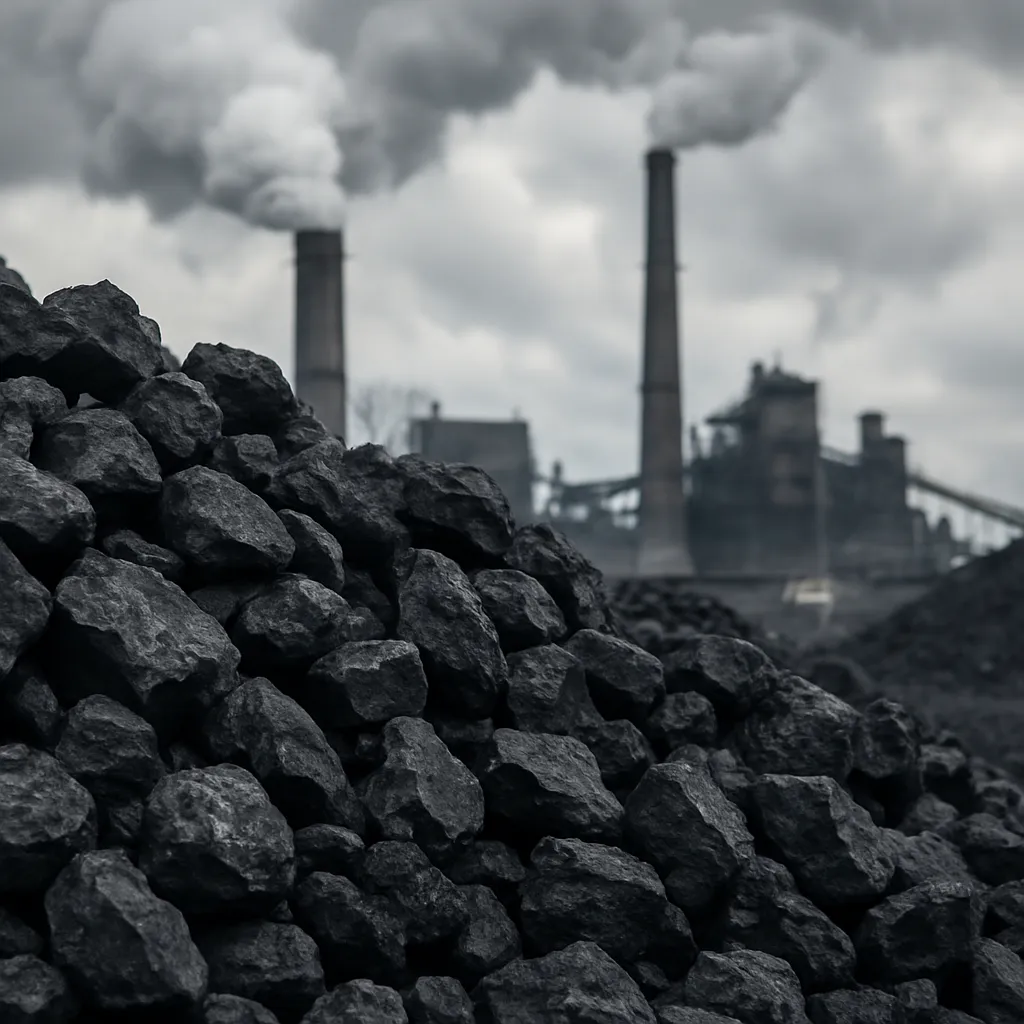
Non-premium steam coal occupies a large and pragmatic niche within the global energy mix. Unlike high-grade or so-called premium coals used in metallurgical processes or selected high-efficiency boilers, non-premium steam coal is a broadly available, often lower-ranked thermal fuel primarily destined for conventional power generation, industrial heat and some district heating systems. This article explores its defining characteristics, where it is found and produced, the economics and trade patterns that drive its market, its role in industry, and some environmental and technological considerations that shape its future.
Characteristics and classification of non-premium steam coal
Coal is classified by rank (lignite, sub-bituminous, bituminous, anthracite) and by end-use (steam/thermal vs. coking/metallurgical). Non-premium steam coal generally refers to thermal coal that does not meet the tighter specifications of premium grades—characteristics such as high calorific value, low ash, low sulfur and low moisture. Typical traits of non-premium steam coal include:
- Lower calorific value (often in the range of 15–25 MJ/kg on an as-received basis depending on moisture and ash).
- Higher ash content (sometimes >10–20%), which increases handling and ash-disposal costs at the plant.
- Higher moisture and volatile matter compared with premium coals, reducing combustion efficiency per tonne.
- Elevated sulfur or trace element content in some deposits, requiring flue gas treatment to meet emissions standards.
From a practical perspective, non-premium steam coal is often blended with higher-grade coals to meet boiler specifications, or it is used in plants designed to tolerate wider quality ranges. Its primary value rests in being an affordable, widely available thermal fuel rather than a material prized for exceptional combustion properties.
Where non-premium steam coal occurs and major producing regions
Coal-bearing basins are distributed worldwide; the geological conditions that created coal do not inherently produce only premium grades. Hence many large producing regions yield significant volumes of non-premium steam coal. Major producers and sources of non-premium steam coal include:
- China — the world’s largest producer and consumer of coal. Chinese mines produce a wide range of qualities, and domestic power plants frequently burn coals that would be classed as non-premium by export standards. Much of China’s coal is high in ash and moisture in certain basins, making it fit the non-premium profile.
- India — heavy reliance on domestic thermal coal (some with high ash content) for electricity generation. Indian coals are often blended or beneficiated for thermal plants.
- Indonesia — a leading exporter of thermal coal, including large volumes of lower-rank, high-moisture coals (sub-bituminous) that are often sold as lower-spec steam coal to Asian markets.
- Australia — produces both high-quality thermal coal and significant volumes of lower-spec steam coal, with a sizeable export sector that accommodates a spectrum of grades.
- Russia — vast coal resources include many deposits yielding coals used for thermal power that do not fit premium specifications, exported to nearby markets as well as used domestically.
- Other notable producers: the United States, South Africa, Colombia and countries in Central Asia and Eastern Europe. The U.S. and South Africa produce a mix of metallurgical and thermal coals; some lignite and sub-bituminous coals from these regions are typical non-premium steam coals.
Many smaller or medium-sized producing countries supply regional markets with thermal coal grades that, while not premium, are vital for local energy security and industrial activities.
Mining, processing and logistics
Extraction methods
Non-premium steam coal is produced via both underground and surface (open-pit) mining. The choice depends on geology, seam depth and local economics. Large surface mines are common in Australia, Indonesia and parts of the U.S., while underground methods are more common in long-established basins in China, Russia and India.
Processing and quality control
Because non-premium steam coal often has higher ash and moisture, coal washing and processing can improve its performance. However, not all lower-spec coals justify intensive beneficiation—the cost of washing or drying must be weighed against the premium achievable in the market. Typical processing steps include crushing, screening, washing and, increasingly, thermal or mechanical drying techniques to reduce moisture for higher calorific performance.
Logistics and handling
Non-premium steam coal is typically moved in large bulk shipments by rail and ship for exported volumes, or by rail and conveyor systems for domestic consumption. Freight costs, port infrastructure and bunker arrangements for shipping are key determinants of delivered price, often representing a substantial share of the cost for exported non-premium coal traded across regions.
Economic and trade statistics
Global coal production and trade are dominated by a few major players, and non-premium steam coal represents a significant share of thermal coal volumes. Some representative figures and patterns (approximate and evolving with market cycles) include:
- Global hard coal production typically ranges in the ballpark of 6–8 billion tonnes annually, with thermal coal forming the bulk of that volume. Lignite production adds several hundred million tonnes in large producing countries.
- Top producers by volume include China (multiple hundreds of millions to well over a billion tonnes annually depending on reporting), India (several hundred million tonnes), the United States, Australia, and Indonesia.
- Major exporters of thermal coal in recent years have included Indonesia, Australia, Russia, Colombia and South Africa. Indonesia in particular has specialized in lower-rank, sub-bituminous thermal coals that are widely characterized as non-premium in many markets.
- Coal accounts for roughly one-quarter to one-third of global electricity generation depending on region and year—this share has slowly declined in some markets due to renewables and gas, but demand for thermal coal can remain resilient in regions where alternatives are limited.
Price dynamics: prices for non-premium steam coal are typically lower than premium thermal or metallurgical grades. Market benchmarks such as API2 (Northwest Europe), API4 (Richards Bay, South Africa) and FOB Newcastle give reference points, but non-premium coals trade at discounts and are price-sensitive to transport costs, seasonal demand and macroeconomic trends. Market volatility has been notable in recent years due to pandemic-related demand shocks, geopolitical disruptions, and changes in energy policy.
Role and significance in industry
Non-premium steam coal plays several practical roles:
- Base-load electricity generation: Many large thermal power stations were built to handle mixtures of coal qualities and can accept non-premium fuels if emissions controls are adequate and blending is used. In countries with limited gas or renewable capacity, non-premium coal ensures reliable baseload supply.
- Industrial heat: Cement, brick, paper and certain chemical processes may use steam coal for kiln and boiler heat. Non-premium coal is often cost-effective for these heat-intensive sectors.
- District heating: In some regions, particularly in Eastern Europe and parts of Asia, coal-fired district heating systems rely on locally mined, lower-grade coals.
- Flexibility and blending: Power plants commonly blend non-premium steam coal with better quality coals or use additive technologies to maintain combustion stability and emissions compliance. This flexibility helps balance overall fuel budgets and manage supply constraints.
The relative affordability of non-premium coal can be a decisive factor for energy planning in developing economies, where cost pressures and growing electricity demand favor cheaper thermal fuels over more capital-intensive alternatives.
Environmental, health and regulatory aspects
Lower-spec coals typically carry environmental challenges: higher ash produces more particulate disposal; higher sulfur or mercury content requires more robust flue gas cleaning; and higher moisture and volatile matter can reduce combustion efficiency leading to greater CO2 emissions per unit of delivered energy. Key considerations include:
- Emissions intensity: On a per-energy basis, lower calorific coals often have higher CO2 emissions because more mass is burned for the same energy output. This is significant where emissions pricing or carbon regulation exists.
- Air pollutant control: Plants burning non-premium coal may need flue gas desulfurization (FGD), selective catalytic reduction (SCR) for NOx, and particulate filters (electrostatic precipitators or fabric filters) to meet air quality standards.
- Waste management: Increased ash volumes require disposal or beneficial use strategies (e.g., cement or construction applications) to reduce environmental footprint and cost.
- Health impacts: Coal mining and combustion carry risks to worker and community health, from dust and particulate matter to heavy metal contamination if not properly managed.
Policy responses vary: some jurisdictions are tightening standards or introducing carbon pricing, which reduces the competitive advantage of non-premium coal, while others maintain or even increase coal use for reasons of affordability and energy security.
Market dynamics, resilience and future outlook
The future of non-premium steam coal depends on a complex interaction of economics, policy, technology and supply. Several trends to watch:
- Demand elasticity: In OECD countries, demand for coal, including non-premium grades, has been declining as gas and renewables grow. However, in parts of Asia and some developing regions, demand remains robust, and lower-cost non-premium coals can preserve competitiveness.
- Technological mitigation: Advances in emissions control (carbon capture readiness, more efficient boilers, co-firing with biomass) can make non-premium coal less damaging per MWh produced, though at increased capital and operating cost.
- Transport and trade routes: Infrastructure investments or disruptions (e.g., port capacity, rail network reliability, geopolitical tensions) can quickly change the desirability of certain non-premium coals for specific markets.
- Price cycles: Non-premium steam coal is sensitive to seasonal electricity demand, global GDP growth and substitution by other fuels. Producers in export-oriented countries may see volatile revenue streams tied to these cycles.
- Decarbonization policies: Stricter climate policies and commitments to net-zero targets will gradually reduce long-term demand for all coal grades. That said, the pace of decline differs by region—some countries announce accelerated coal phase-outs, while others prioritize economic development and remain committed to coal for decades.
Interesting facts and lesser-known aspects
– Some non-premium coals can be upgraded economically through dry-separation technologies or thermal dryers; these processes are gaining traction where moisture reduction yields significant transport or combustion benefits. Beneficiation is therefore not limited to premium coals.
– In certain industrial clusters, waste coal and low-grade seams that were once uneconomic are being redeveloped with modern mining and processing to supply local plants—turning past liabilities into energy resources.
– Non-premium steam coal trade patterns closely follow infrastructural realities: for example, proximity to large port facilities or major rail lines can make otherwise low-value coal commercially viable for export markets.
– The term non-premium is context-dependent: a coal considered non-premium in one region (by calorific value or ash) might be prized in another where that specific quality suits a particular boiler or where price sensitivity dominates.
Practical considerations for stakeholders
For utilities, industrial users and policymakers, managing non-premium steam coal involves multiple trade-offs:
- Cost vs. performance: Lower fuel cost must be balanced against higher plant maintenance, ash handling, and emissions control expenses.
- Supply security: Relying on locally available non-premium coal can enhance energy security but may require investment in plant flexibility or emissions control.
- Regulatory compliance: Planning for future emissions rules or carbon pricing is essential to avoid stranded assets when basing capacity decisions on low-cost, lower-quality coal.
- Investment in efficiency: Improving thermal efficiency at the plant level (e.g., through retrofits or co-firing strategies) can significantly reduce the environmental penalty of burning lower-quality coal.
Summary
Non-premium steam coal remains a cornerstone of energy systems in many parts of the world. Its abundance and affordability make it an attractive option for power generation and industrial heat where alternatives are constrained by cost, infrastructure or availability. However, the environmental and operational drawbacks—higher ash, moisture and emissions intensity—require careful management through beneficiation, plant design, emissions controls and strategic policy. The global role of non-premium steam coal is evolving: while long-term decarbonization trends present a headwind, regional demand and practical realities ensure that this category of coal will remain relevant for years, especially in energy systems prioritizing reliability and cost-effectiveness.