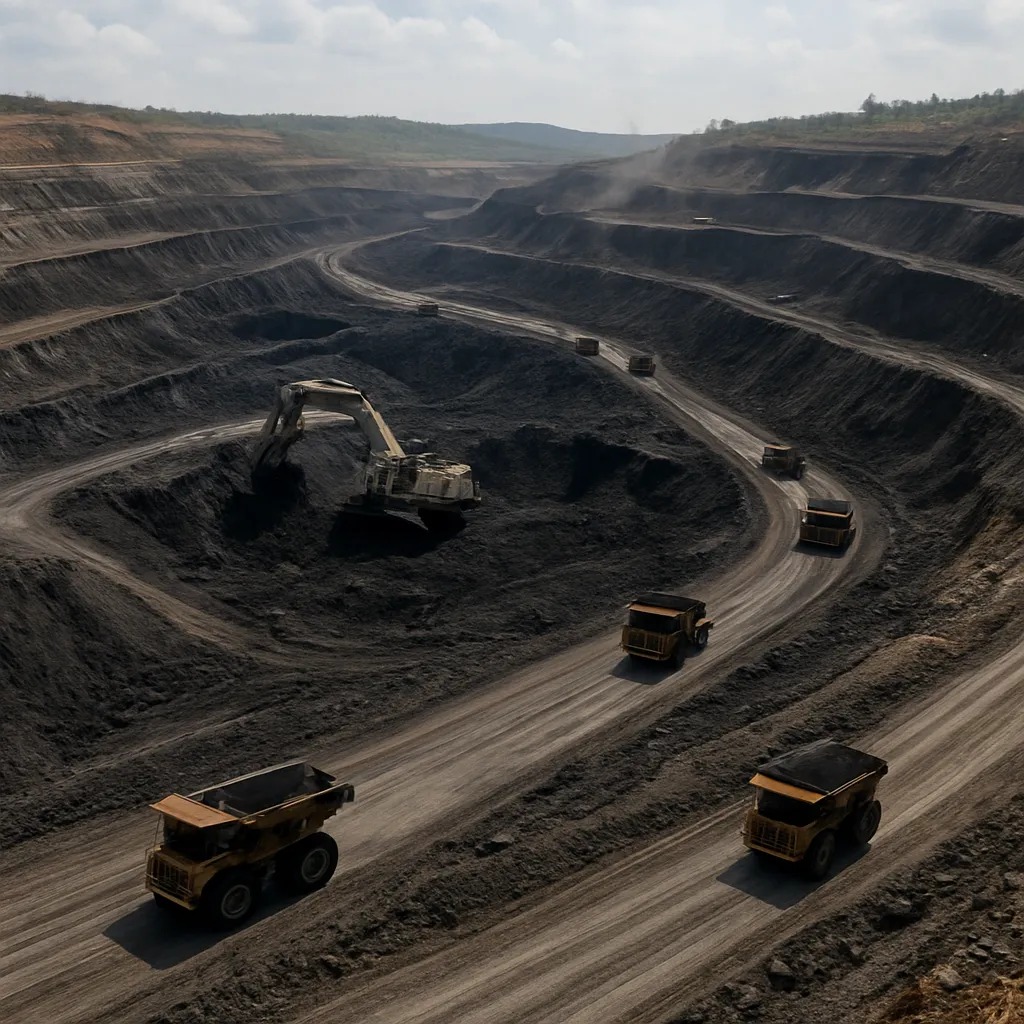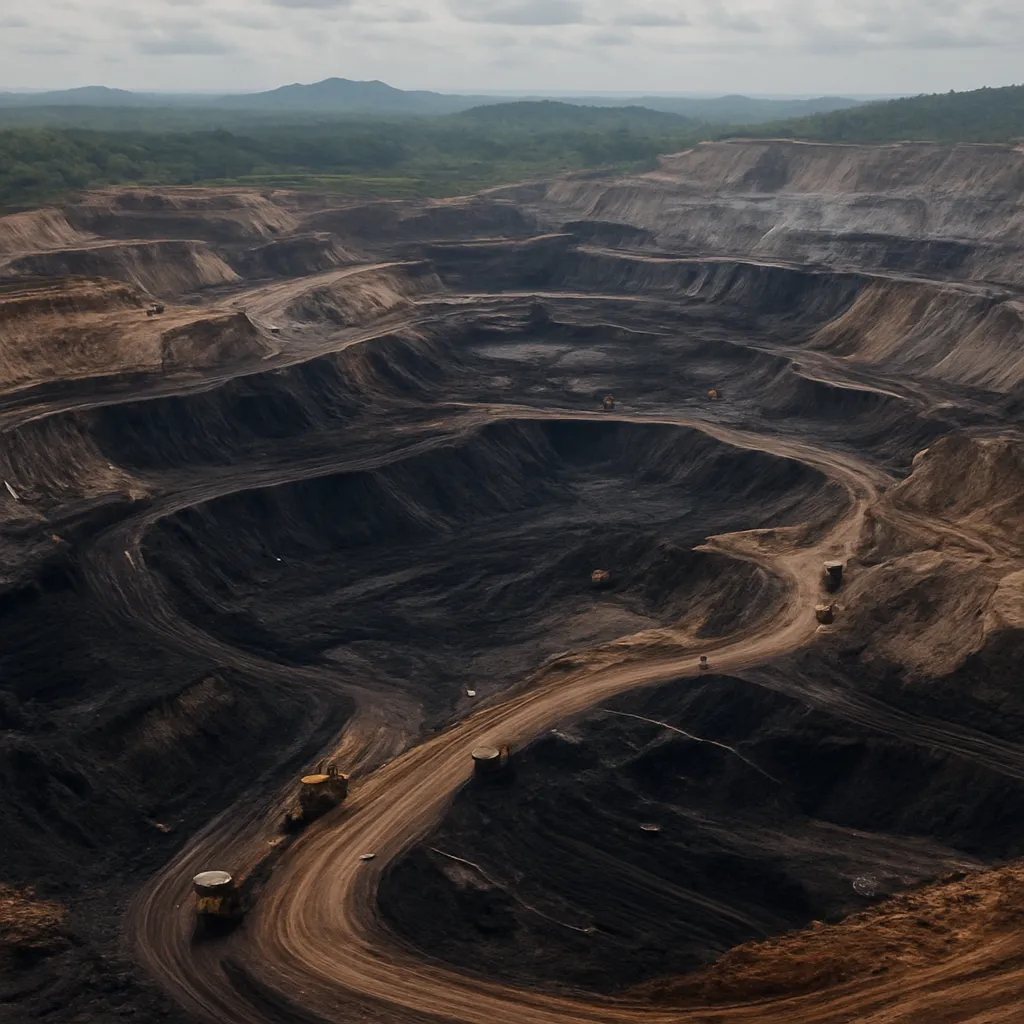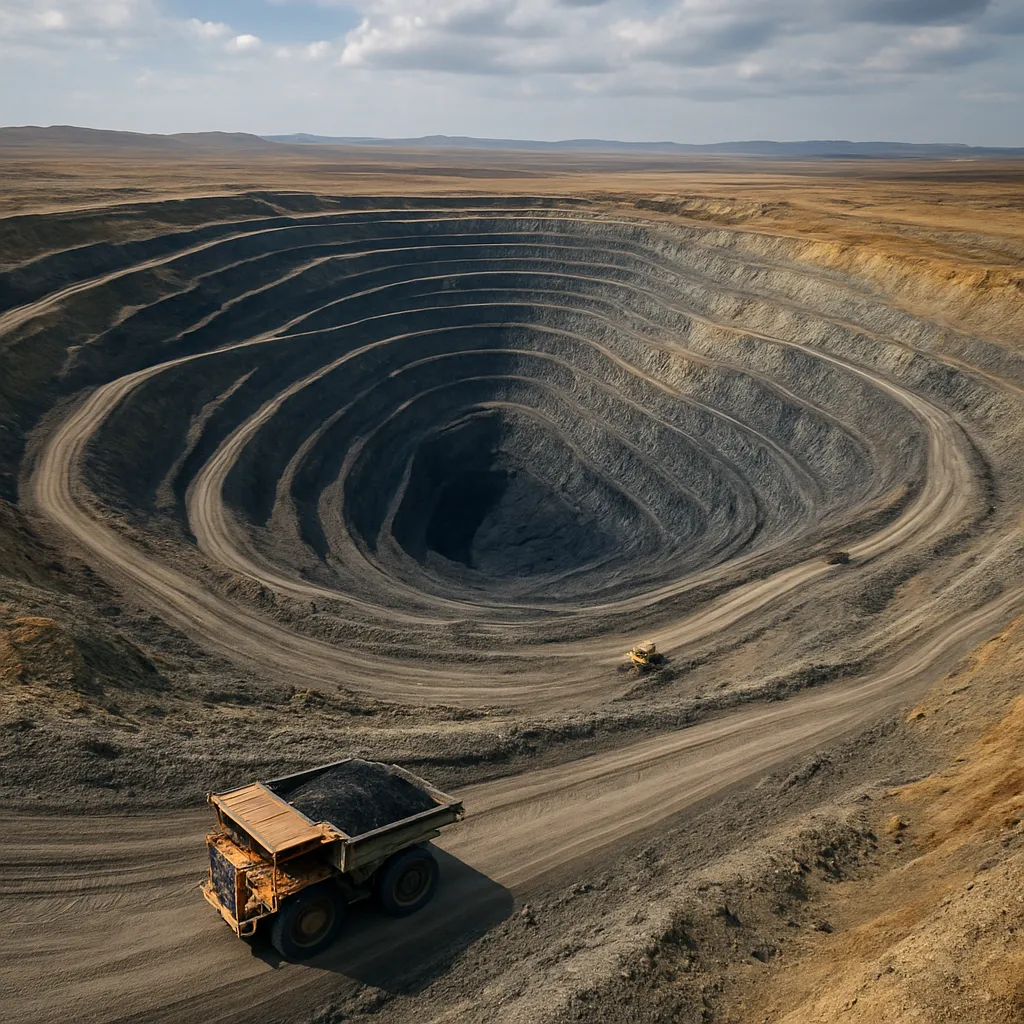
The Deep Pit at the Erdenes Tavan Tolgoi complex in southern Mongolia is one of the most significant coal mining sites in the world’s Inner Asia region. Located in the arid reaches of the Gobi Desert, the deposit sits at the heart of a broader mining district that has reshaped Mongolia’s economy over the last decade. This article describes where the mine is located, the types of coal produced, geological and statistical estimates of resources, economic and logistical roles in regional trade—especially with China—and the environmental, social and strategic challenges that accompany large-scale extraction in a fragile ecosystem.
Location and geological setting
The deposit commonly known as Erdenes Tavan Tolgoi lies in the Tsogt‑Tsetsii district of the southern Umnugovi (South Gobi) province of Mongolia. The name Tavan Tolgoi literally means “five hills” in Mongolian and refers to a large coalfield composed of multiple adjacent seams and mining blocks. The area is part of the wider Gobi Basin, an arid region underlain by Mesozoic and Cenozoic sedimentary sequences that host prolific coal seams.
Geologically the field contains multiple coal seams of varying thickness and rank. These seams formed in continental basins and were subject to different burial and thermal histories, producing both high‑rank metallurgical coals and lower‑rank thermal coals. The resource distribution across the field is heterogeneous: some blocks are dominated by high‑quality hard coking coal, while other blocks contain sub‑bituminous or thermal coal suited to power generation. The so‑called “Deep Pit” refers to a portion of the deposit where mining has extended to substantial depths to access higher‑grade seams and larger continuous reserves.
Types of coal and mining methods
The Tavan Tolgoi region is notable for producing both metallurgical and steam coals. In simple terms, this means the site yields both coking coal—used primarily in steelmaking—and thermal coal—used for electricity generation and heating.
- High‑quality coking coal: concentrated in some of the eastern and central seams, this coal is valued for its low ash and sulfur content and its ability to form coke when heated in the absence of air. This fraction commands a premium on international markets, particularly from customers in northeastern China and regional steelmakers.
- Thermal coal: present in other seams and in parts of the Deep Pit, this material is used domestically and exported for power generation. It typically sells at lower prices than metallurgical coal but still represents an important revenue stream.
Mining at the Deep Pit and adjacent open‑pit operations is primarily by large-scale open‑pit extraction methods: drilling and blasting (where required), electric and diesel shovels or excavators, haul trucks, and conveyor systems. Overburden removal and benching are carefully planned to maintain pit stability. In deeper parts of the deposit, benches become higher and haul distances increase, affecting production economics. There have also been feasibility talks and technical studies into potential underground mining for some deeper, higher‑grade seams, but the predominant method remains open pit due to economics and ease of mechanization.
Reserves, production and statistical overview
Estimating exact reserves and annual output for a complex like Tavan Tolgoi is challenging because figures vary by assessment method, reporting year and the distinction between geological resources and economically recoverable reserves. Nevertheless, a number of consistent estimates provide a useful picture:
- Resource estimates: The entire Tavan Tolgoi coalfield is often cited as containing between approximately 6 and 7 billion tonnes of in‑place coal resources. Various technical reports and government disclosures generally cluster around ~6.4 billion tonnes as a working figure for the deposit’s total coal resource base.
- Recoverable reserves: Economically recoverable reserves—those accessible with current technology and infrastructure—are smaller than in‑place resources. Conservative estimates of recoverable reserves often range from several hundred million tonnes to multiple billions of tonnes depending on cut‑off grades and market conditions; much depends on which blocks (East, West, South, Deep Pit) are being considered and the investment made in infrastructure.
- Annual production: Production from Tavan Tolgoi and related South Gobi mines has historically been variable, influenced by Chinese demand, weather, and logistics. At times the site and associated operators have produced and exported in the range of tens of millions of tonnes per year; in other years, constrained rail and port capacity and price fluctuations have reduced throughput. A reasonable summary is that the complex is capable of delivering annual output on the order of several million to tens of millions of tonnes depending on ramp‑up and infrastructure.
Some concrete numbers reported in various public disclosures and media over the years include years when national coal exports from Mongolia reached the tens of millions of tonnes, with a major share originating from Tavan Tolgoi. These figures underscore the deposit’s scale relative to Mongolia’s overall coal industry.
Ownership, governance and the role of the state
The mine is operated under the aegis of the state‑owned mining company created to manage the national interest in the deposit. The enterprise established by the Mongolian government—whose name includes the company brand Erdenes—has played a central role in coordinating development, negotiating with foreign partners, and managing production. Ownership and governance of such a strategic asset have been politically sensitive and have prompted debates about sales of equity to foreign investors, participation of Chinese and international mining companies, governance transparency and how best to capture value for national development.
The state’s approach has emphasized maintaining significant control while attracting necessary capital and technical expertise. Over the years there have been discussions about partial privatization, share placements and joint ventures, and all these options have been evaluated against the backdrop of national expectations that resource revenues should finance infrastructure, social programs and diversification efforts.
Logistics, exports and market dynamics
A key economic reality for Tavan Tolgoi is that most of its coal is exported to neighboring markets, particularly China. The deposit’s proximity to the Chinese border gives it a natural logistical advantage, but the heavy and continuous flow of coal has made transport infrastructure a major constraint.
- Border crossings: Road export historically relied on trucking convoys to border points such as Gashuunsukhait and Shiveekhuren, routes that are heavily used and seasonally affected. Trucking is flexible but expensive and has environmental impacts (dust, wear on roads, local traffic issues).
- Railway issues: Railway capacity is the long‑term solution to scale exports. Several railway proposals and projects have been associated with the region—including dedicated links from the Tavan Tolgoi area toward the Chinese border and broader Trans‑Mongolian connections. Building rail lines is capital‑intensive and politically sensitive because routing has implications for transit fees, sovereignty and bilateral relations.
- Market demand: Chinese steelmakers and power generators have been the primary consumers. Demand in China—driven by industrial output, steel demand, and seasonal thermal needs—largely determines Mongolian coal prices and volumes. Over the last decade commodity cycles have produced high prices during construction booms and lower prices during global slowdowns, affecting revenues from the mine.
Tavan Tolgoi’s exports represent a significant portion of Mongolia’s total export earnings from coal. This creates both opportunity and dependency: export revenues can finance development and public investment, but they also expose the country to commodity price volatility and demand shocks from its largest trading partner.
Economic and social significance
The economic importance of the site to Mongolia cannot be overstated. A few key contributions include:
- Revenue generation: Royalties, taxes, dividends and export proceeds from Tavan Tolgoi form a critical component of Mongolia’s fiscal base. The state company’s receipts have funded infrastructure projects, social programs and, at times, fiscal stabilization measures.
- Employment: The mine and its logistics chain employ thousands of workers directly and indirectly. Jobs include mine engineers, equipment operators, truck drivers, administrative staff, security, and service providers supporting camps and communities in the South Gobi.
- Regional development: The presence of the mine has accelerated local development—roads, temporary housing, power supply and small commercial networks in the Tsogt‑Tsetsii district. However, this has also produced social stresses as rapid change influences nomadic livelihoods and local governance.
At the macro level, revenues from coal and other minerals mean that mining output—led by assets such as Tavan Tolgoi—can account for a large share of GDP growth, government revenue, and export receipts in any given period. This centrality also means that policy choices about mining, revenue allocation and environmental protections have broad political significance.
Environmental and social impacts
Large open‑pit coal mining in a fragile desert environment brings a set of environmental and social challenges that require careful management:
- Water use and scarcity: Mining and associated processing and camps consume water in a region with very limited water resources. Balancing industrial water needs with the requirements of local herding communities and ecosystems is a persistent policy issue.
- Dust and air quality: Dust from blasting, excavation, haul roads and coal handling contributes to local air quality degradation. Dust control measures—spraying, covered conveyors and road sealing—are implemented selectively depending on cost and oversight.
- Land disturbance and rehabilitation: Open pits remove large tracts of land and alter landscapes. Progressive reclamation and closure planning help mitigate long‑term impacts but require funding and commitment over decades.
- Social change: Rapid migration of workers, influx of capital and shifts away from traditional pastoral activities have social consequences for households, cultural continuity and local governance.
- Climate implications: The extraction and combustion of coal contribute to greenhouse gas emissions. International climate policy and shifts to lower‑carbon energy sources create long‑run demand risk for thermal coal in particular.
Challenges and controversies
Several recurrent themes have complicated the development of the Deep Pit and the broader Tavan Tolgoi complex:
- Infrastructure bottlenecks: Lack of sufficient rail transport has periodically limited volumes that can be economically exported. Building railways involves financing, land tenure, and cross‑border coordination.
- Governance and transparency: Debates over state share sales, contracting practices, and the distribution of benefits have led to domestic political scrutiny. Ensuring transparent tendering, revenue management and environmental oversight remains a priority to maintain public trust.
- Market concentration: Heavy reliance on one export market (China) creates risk exposure. Any change in Chinese demand, regulations on coal imports, or competition from other suppliers affects revenue streams quickly.
- Environmental pushback: As global climate policy gains momentum, financiers and international customers may place greater constraints on thermal coal trade, pressuring Mongolia to diversify revenue sources or focus more on high‑value metallurgical coal and cleaner operations.
Future prospects and strategic considerations
Looking ahead, the future of the Deep Pit and the larger Tavan Tolgoi project will be shaped by a combination of technical, economic and political factors:
- Infrastructure investments: Completion of dedicated rail links or major upgrades to border logistics will be decisive in unlocking higher sustained output and lowering unit transport costs.
- Market segmentation: A strategy that prioritizes extraction and marketing of high‑grade coking coal could yield greater value per tonne and reduce vulnerability to thermal coal price swings. Increased beneficiation and quality control at source enhance market access.
- Revenue management: How Mongolia allocates proceeds from the mine—toward infrastructure, sovereign wealth funds, or social programs—will influence long‑term development outcomes and public perception of the project’s benefits.
- Environmental adaptation: Investments in mitigation—dust suppression, water efficiency, progressive rehabilitation—and in emission reduction strategies for downstream users (e.g., more efficient coal use in steelmaking) will help mitigate reputational and regulatory risks.
- Technological change: Automation, improved mine planning and the adoption of lower‑emission freight technologies could improve productivity and lower environmental footprints over time.
Interesting facts and broader significance
Some notable points that illustrate the significance of the site:
- Tavan Tolgoi is frequently mentioned among the world’s largest standalone coal deposits by resource size, making it an asset of regional strategic importance.
- The project’s name—Tavan Tolgoi—reflects the local landscape and cultural identity, tying a national narrative to a major economic asset.
- Development decisions at the site influence bilateral relations with neighboring countries due to the export dependency and the need for cross‑border transport infrastructure.
- Production from the Deep Pit has both immediate local economic importance and broader fiscal implications for national budgeting and macroeconomic stability.
In summary, the Deep Pit at the Erdenes Tavan Tolgoi complex is a cornerstone of Mongolia’s coal industry. It produces both high‑value coking coal and significant quantities of thermal coal, sits atop estimated in‑place reserves of several billion tonnes, and drives a large share of the country’s export receipts and industrial employment. At the same time, its long‑term value depends on improvements in railway and logistics infrastructure, careful environmental management, transparent governance under the state enterprise structure, and the ability to navigate shifting global energy and steel markets—particularly demand from China. For Mongolia, Tavan Tolgoi is not just a mine: it is a strategic economic lever whose stewardship will shape the country’s development trajectory for decades to come.