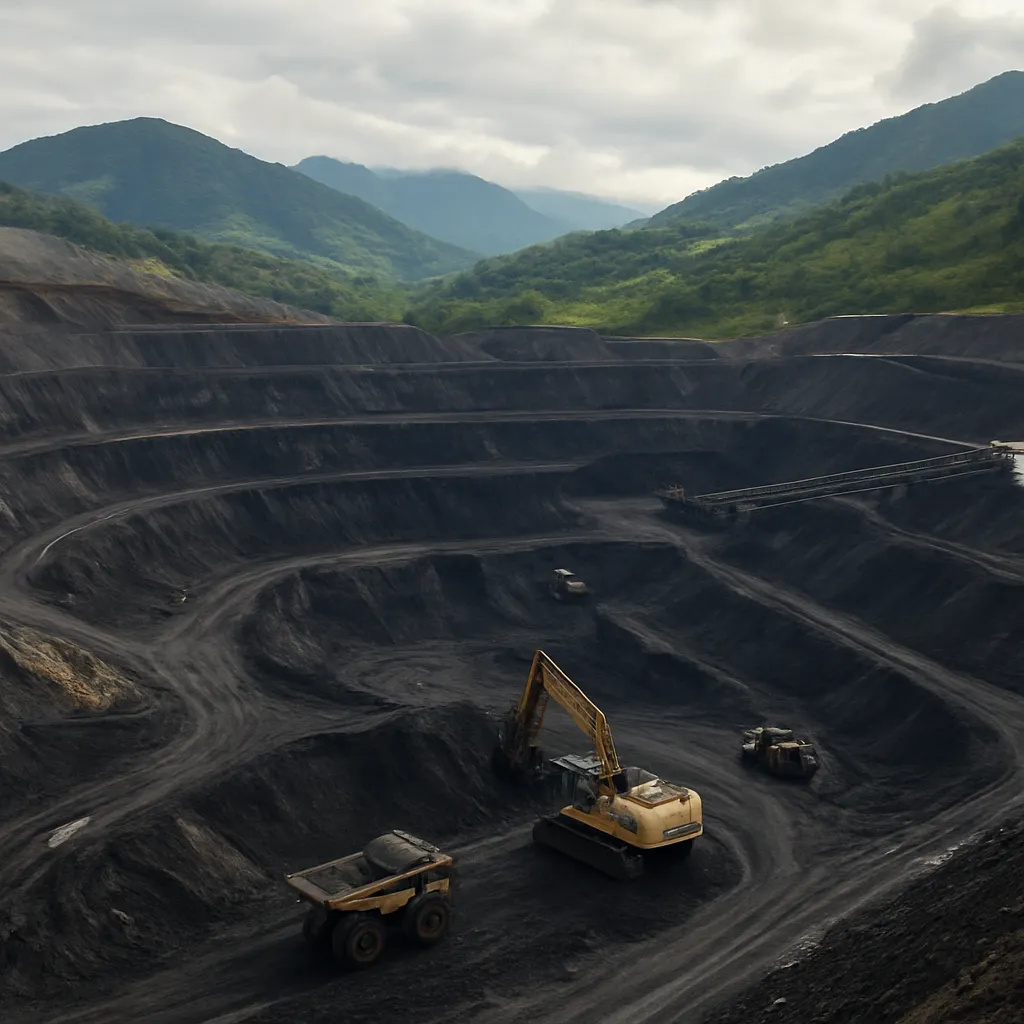
Cerro Azul Coal Mine is one of the numerous coal operations located in Colombia, a country that for decades has been a major exporter of thermal coal. This article provides a comprehensive overview of Cerro Azul—its location within Colombia’s coal-producing landscape, the type and quality of coal associated with the site, operational characteristics, economic and statistical context, environmental and social considerations, and the mine’s potential future trajectory. Where precise public data about Cerro Azul are limited, the discussion places the mine in the broader framework of Colombia’s coal industry to give context for its likely significance and impacts.
Location, geology and geological context
The Cerro Azul Coal Mine lies within the realm of Colombia’s coal-bearing basins, which include the Cesar-Ranchería Basin in the north-central region and the La Guajira Basin in the extreme northeast. Colombia’s major coal deposits are concentrated in these northern departments, which have formed over geological time from extensive peat accumulation and subsequent burial and coalification. While Cerro Azul is not among the globally prominent names such as Cerrejón, it is part of the network of mines and projects that together make Colombia a leading coal supplier to global markets.
Geology and coal type
- Coal rank: The coal associated with northern Colombian basins is typically thermal in nature—ranging from sub-bituminous to bituminous ranks. Such coals are primarily used for power generation and industrial heat.
- Quality characteristics: Colombian coals are often valued for relatively low sulfur content and competitive calorific values compared with many other export coals. Ash content and moisture can vary between deposits and seams.
- Seam geometry: Seams in the region commonly vary in thickness from a few meters to tens of meters; continuity and overburden depth determine whether a deposit is developed as an open pit or underground operation. Much of Colombia’s large-scale production has historically come from open-pit mines.
Given the general regional geology, Cerro Azul’s coal is most plausibly a thermal, low-to-moderate rank coal suited to export markets and domestic power generation. Without publicly released drilling and reserve reports specifically for Cerro Azul, detailed seam, reserve and grade numbers remain unavailable in the public domain.
Mining operations, processing and logistics
Mining operations at Cerro Azul, as with many Colombian coal operations, follow standard industry practices adapted for local conditions. The predominant method for large-scale, shallower deposits in Colombia is open-pit mining, which allows economical extraction of extensive seams. Where seams are deeper or more structurally complex, selective underground methods or combined approaches may be used.
Extraction and processing
- Extraction: Heavy earthmoving equipment—draglines, shovels, haul trucks—are typical for open-pit extraction. For underground workings, mechanized longwall or room-and-pillar techniques are used where appropriate.
- Coal handling: After extraction, coal typically goes through on-site processing such as crushing, screening and sometimes washing to reduce ash and separate impurities. Quality control is critical for meeting export contract specifications.
- Safety and workforce: Colombian mines operate under national safety regulations with industry-standard training, emergency preparedness and occupational health programs. Workforce size varies with mine scale; many medium-sized mines directly employ hundreds of workers and indirectly support thousands through contractors and service providers.
Transport and export infrastructure
Transport logistics are crucial to any Colombian coal mine’s economics. Northern coal operations commonly use rail corridors and coastal ports to reach export markets. Major export outlets in northern Colombia include ports such as Puerto Bolívar and facilities near Santa Marta and Barranquilla. Depending on Cerro Azul’s precise location, its logistical chain likely involves a combination of:
- On-site loading facilities and stockyards
- Short-distance haul roads connecting to main rail lines or highways
- Interconnection with export terminals or barge/river transfer where available
Efficient logistics and port access are among the main cost drivers for Colombian coal competitiveness in overseas markets.
Economic role and statistical context
Coal has been a cornerstone of Colombia’s extractive export economy for decades. While global attention often centers on the nation’s oil and emerging minerals, coal remains one of Colombia’s most important commodity exports, historically providing foreign exchange and employment in producing regions. Cerro Azul contributes—directly and indirectly—to local economic activity through employment, supplier contracts and fiscal flows.
Production and reserves (contextual)
- Publicly available, mine-specific production statistics for Cerro Azul are limited. Many smaller and medium-sized operations report production in corporate filings or government registers, but not all data are consistently publicized.
- For context, Colombia’s national coal production historically ranged from a few dozen million tonnes per year to higher peaks depending on global demand cycles. The largest single mine, Cerrejón, produced on the order of tens of millions of tonnes per year in past decades, illustrating the scale of the national industry compared to smaller mines such as Cerro Azul.
Because Cerro Azul’s exact production and reserve numbers are not broadly published, it is most informative to position the mine relative to national averages: small-to-medium coal operations in Colombia commonly produce from fractions of a million tonnes up to several million tonnes annually, depending on deposit size, capital investment and market access.
Fiscal contributions and local economy
Coal mining contributes to public revenues via taxes, royalties and employment-related levies. Those funds, when allocated to regional development, can materially affect local infrastructure, social services and economic diversification efforts. At the company level, operational expenditures—including purchases of fuel, equipment, services and wages—stimulate the regional economy surrounding Cerro Azul.
- Employment: A mine like Cerro Azul typically employs a mix of local workers and specialized staff. Direct employment supports local households; indirect employment arises from suppliers, logistics providers and service contracts.
- Public revenues: National and subnational governments receive revenues that can be reinvested into community projects, though the effectiveness and transparency of such allocations vary by jurisdiction.
- Foreign exchange: If Cerro Azul exports coal, earnings contribute to Colombia’s export revenues and trade balance.
Environmental, social and regulatory considerations
Coal mining presents well-documented environmental and social challenges. Colombian regulations require environmental impact assessments, permits and mitigation plans for mines. For Cerro Azul, contemporary practice would involve detailed environmental management programs addressing land use, water, air quality and biodiversity.
Key environmental factors
- Land disturbance: Open-pit mining transforms landscapes; progressive rehabilitation and final reclamation plans are essential to restore ecosystems and productive land uses.
- Water resources: Protection of local water bodies from sedimentation and contamination is a priority. Water management includes treatment systems, controlled drainage and monitoring programs.
- Air quality: Dust management—via water sprays, vegetative buffers and covered conveyors—is important to limit particulate emissions affecting communities and workers.
- Biodiversity: Mines often conduct baseline biodiversity surveys, and mitigation measures may include habitat offsets or restoration to comply with environmental permits.
Social impact and community relations
Community relations are central to sustainable operations. Mines like Cerro Azul must navigate issues including land use conflicts, involuntary resettlement (where applicable), employment expectations and benefit-sharing. Effective community engagement programs include:
- Stakeholder consultation and transparent grievance mechanisms
- Local hiring and training initiatives
- Investment in local infrastructure—roads, schools, health facilities
- Support for economic diversification to reduce dependency on mining
Regulatory oversight by national and regional agencies, combined with corporate social responsibility practices, shapes the social footprint of mining operations. International financing and offtake partners increasingly expect robust social and environmental governance practices.
Significance in the industry and strategic outlook
Cerro Azul’s significance should be judged in the broader context of Colombia’s coal sector and global energy trends. While large mines dominate export volumes, a network of small and medium operations provide regional employment and feed local economies. Key considerations for Cerro Azul’s future include market demand for thermal coal, regulatory pressure tied to climate policies, and the company’s ability to maintain social license and implement sustainable practices.
Market and demand factors
- Export markets: Colombia historically exported coal to North America, Europe and increasingly to Asia. Demand depends on global thermal coal consumption, power sector dynamics in importing countries and competition from alternative suppliers.
- Price volatility: Thermal coal prices can be volatile, affecting mine profitability. Mines must manage cost structures and logistics to remain competitive.
- Energy transition: Long-term declines in thermal coal demand due to decarbonization policies pose strategic challenges. However, demand in some regions and for certain coal qualities is expected to persist in the near to medium term.
Regulatory and financing environment
Investors and lenders are increasingly evaluating sustainability and climate risk. Mines with strong environmental management, transparent governance and plans for closure/reclamation are more likely to secure financing and offtake agreements. Cerro Azul’s ability to meet environmental standards, reduce greenhouse gas intensity where feasible, and demonstrate responsible community engagement will shape its access to capital and markets.
Opportunities and challenges
- Opportunities: Operational efficiency improvements, coal quality optimization (washing and blending), local beneficiation and logistical enhancements can add value. Participation in regional development projects and diversification into non-coal activities can increase long-term resilience.
- Challenges: Market headwinds from decarbonization, potential regulatory tightening, community expectations and environmental liabilities constitute ongoing risks.
Additional technical, social and historical notes
Beyond basic operational and economic aspects, several additional points are relevant to understanding mines like Cerro Azul in Colombia:
- Historical development: Many Colombian coal projects evolved from exploration phases to full-scale production over decades, shaped by commodity cycles and infrastructure development.
- Local supply chains: Mines stimulate local service sectors—maintenance workshops, fuel supply, catering, and transportation—which can grow into independent local industries.
- Closure planning: Modern mining practice requires closure and post-closure plans that define how land is returned to productive use and how environmental liabilities are managed.
- Technological adoption: Automation, fuel-efficient fleets and remote monitoring are increasingly used to lower costs and improve safety.
Conclusion and practical perspective
Cerro Azul Coal Mine represents one component of Colombia’s broader coal mining fabric—an industry that has provided significant export earnings and regional employment but faces evolving technical, environmental and market challenges. While detailed mine-level statistics for Cerro Azul are not widely publicized, its likely status as a small-to-medium-sized thermal coal producer places it within a class of operations that must balance operational efficiency, community relations and environmental management to remain viable. The coming decade will test the adaptability of such mines in the face of global energy transition pressures and shifting market dynamics.
Cerro Azul, coal, Colombia, Cerrejón, thermal, exports, reserves, infrastructure, sustainability, employment


