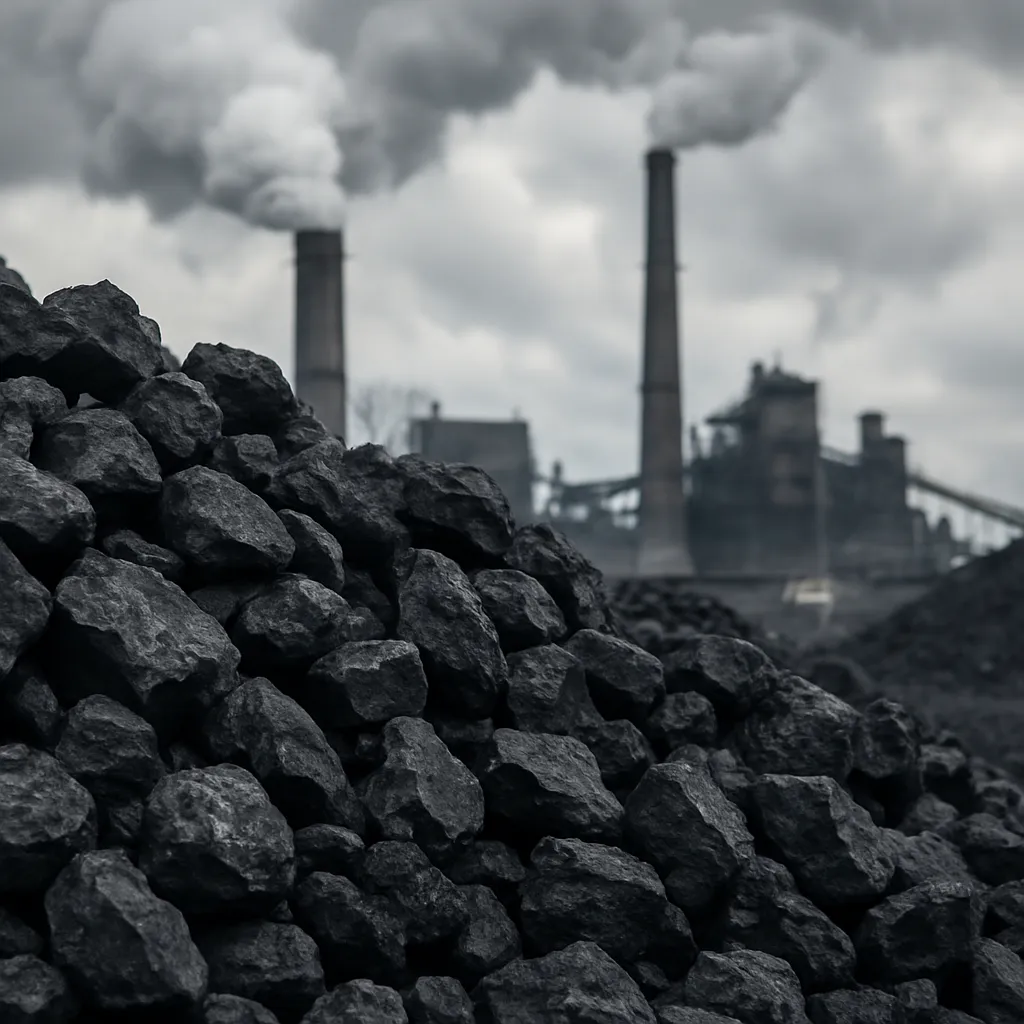
Standard steam coal is a widely used form of coal designed primarily for heat and power applications. It is a cornerstone fuel for many electricity systems and industrial boilers, characterized by specific quality parameters that make it suitable for combustion in thermal power stations. This article examines where standard steam coal occurs, how and where it is mined, its economic and statistical significance, its role in industry, and other noteworthy technical and environmental aspects.
Geology, formation and global occurrences
Coal is a sedimentary rock formed from the compacted remains of ancient vegetation in swampy, anoxic environments over geologic time. Steam or thermal coal originates from plant material that has undergone varying degrees of diagenesis and coalification, producing ranks from lignite and sub-bituminous through bituminous to anthracite. Most commercial steam coal is in the sub-bituminous to bituminous range, offering a balance between energy content and combustion behavior appropriate for power plants.
Where standard steam coal is found
- Major coal-bearing regions include the Permian, Carboniferous and younger basins of Eurasia, the Gondwana-derived basins of Australia and South Africa, and Cenozoic and Mesozoic basins elsewhere.
- In the United States, the Powder River Basin (Wyoming and Montana) is the world’s largest contiguous source of low-rank thermal coal, notable for its vast tonnages but relatively low calorific value and low sulfur.
- Russia’s large deposits in Kuznetsk (Kuzbass) and the Pechora and Kansk-Achinsk basins supply both domestic and export markets.
- China’s major basins (e.g., Shanxi, Inner Mongolia, and the northeast) produce the bulk of the country’s thermal coal for massive domestic consumption.
- Indonesia, with deposits in Sumatra and Kalimantan, is a dominant supplier to Asian thermal coal markets due to extensive open-pit mining and low-cost freight logistics.
- Australia’s Bowen Basin and other Queensland/New South Wales basins produce high-volume exports to Asia, while South Africa’s Highveld and Mpumalanga fields supply domestic and regional markets.
Typical geological settings for steam coal are fluvial-deltaic and coastal plain environments where plant debris accumulated in conditions that limited decay. These depositional conditions often create thick, laterally continuous coal seams suitable for large-scale open-pit or longwall mining.
Physical and chemical characteristics of standard steam coal
Standard steam coal is specified to meet the needs of boilers and furnaces. Important parameters include calorific value, moisture, ash, sulfur, volatile matter and grindability. Contracts for international trade frequently specify a standard or reference coal quality (for example, a 5,500 or 6,000 kcal/kg product on a gross as-received basis), and physical handling characteristics.
- Calorific value: Typical Gross Calorific Value (GCV) for standard steam coal used in international trade commonly ranges from about 4,500 to 6,500 kcal/kg (approximately 18–27 MJ/kg). Trade coal grades are often referred to by a target GCV (e.g., 5,500 kcal GAR).
- Moisture: Moisture content varies with rank; low-rank coals (lignite, sub-bituminous) have higher inherent moisture (up to 30% in some cases), while bituminous coals have lower moisture (<10%). High moisture reduces delivered energy per tonne.
- Ash: Residual mineral matter after combustion, typically expressed as a percentage. Steam coals might have ash contents from <5% to >30%. Lower ash is preferred because it reduces slagging and waste disposal costs.
- Sulfur: Sulfur content influences SO2 emissions; international thermal coals often range from <0.5% sulfur (low-sulfur) to >2% for higher-sulfur varieties. Flue gas cleaning requirements rise with sulfur.
- Volatile matter and fixed carbon affect ignition and combustion characteristics; volatile-rich coals ignite more readily but may produce more particulate emissions.
Specifications for “standard” steam coal therefore balance quality (GCV, ash, sulfur) and cost. Many utility boiler operators blend coals from different sources to meet target furnace conditions and emissions constraints.
Mining methods and processing
Steam coal is mined using both surface (open-pit) and underground methods. The method chosen depends primarily on seam depth, thickness and geology.
Surface mining
- Open-pit and strip mining account for a large share of global coal production, especially in basins like the Powder River Basin, Indonesian opencast sites, and many Australian operations. Surface mining yields large volumes at relatively low cost per tonne and is preferred where seams are shallow and laterally extensive.
Underground mining
- Longwall and room-and-pillar are common underground methods. Longwall mining can recover a high proportion of coal in thick, continuous seams (typical in parts of China, Russia, Poland and the US Appalachian Basin).
Processing and logistics
- Coal washing reduces ash and sulfur and improves calorific value. Washed coal is preferred for higher efficiency and cleaner combustion.
- Loading, transshipment and port logistics are critical for export-oriented coal supply chains. Major port hubs and rail links (e.g., Newcastle in Australia, Richards Bay in South Africa, ports in Indonesia) underpin global thermal coal trade.
- Standard freight and trade benchmarks include indices traded on exchanges and over-the-counter markets; these influence contract pricing and spot transactions.
Economic and statistical overview
Coal continues to be one of the world’s most traded and consumed energy commodities, despite long-term trends toward decarbonization in many regions. Below are key economic and statistical aspects relevant to standard steam coal.
Global production and consumption
- Global coal production runs into the billions of tonnes annually. In recent years the world produced on the order of 7–8 billion tonnes of coal per year (lignite and hard coal combined), with thermal coal representing the majority of that volume because most coal is burned for power and heat.
- China is both the largest producer and consumer of coal by far, accounting for roughly half of global production and a significant share of global consumption. Other large producers include India, the United States, Indonesia, Australia and Russia.
- Coal’s share of global electricity generation historically sat in the 35–40% range in the early 2020s, although this share varies by country and is influenced by policy and fuel switching.
Major exporters and importers
- Key exporters of thermal coal include Indonesia and Australia (both major suppliers to Asian markets), Russia, South Africa and the United States (to some degree). Indonesia often ranks as the largest exporter of thermal coal by volume.
- Major importers include China (though it is largely self-sufficient, it imports specific grades and certain port-proximal supplies), India, Japan, South Korea, Taiwan and several Southeast Asian countries.
Coal prices are influenced by demand from power sectors, seasonal factors, logistics constraints (rail and port capacity), and geopolitical events that affect trade flows. During 2021–2022, thermal coal prices experienced exceptional volatility due to post-pandemic demand rebounds, supply chain bottlenecks and geopolitical tensions, which underscored the commodity’s sensitivity to systemic shocks.
Role in industry and energy systems
Standard steam coal’s primary role is generating heat for industrial processes and electricity generation in thermal power plants. Its attributes make it a widely used dispatchable fuel that supports grid stability where intermittent renewables are significant.
- Electricity generation: Coal-fired thermal power plants remain a core component of many national grids because they can provide baseload or flexible dispatch and are often the lowest-cost source where coal is locally abundant.
- Industry uses include process heat, steam generation, and in some cases co-generation for combined heat and power (CHP) plants in industrial complexes.
- Although steel production relies principally on metallurgical (coking) coal, steam coal can play a role in non-metallurgical heating and in some processes when coke/PCI coal is not required.
- Co-firing coal with biomass or blending different coals helps utilities meet emissions targets while keeping existing infrastructure in use.
Environmental, regulatory and social considerations
Coal combustion produces carbon dioxide (CO2), sulfur dioxide (SO2), nitrogen oxides (NOx), particulate matter and trace metals. The environmental footprint of steam coal extends from mining impacts (land disturbance, water use, acid drainage) to air pollution and greenhouse gas emissions at combustion.
- Emissions: Thermal coal combustion is a major source of CO2 emissions; policy efforts to limit climate change focus on reducing coal use, increasing efficiency of coal plants (supercritical and ultra-supercritical technologies) and deploying emissions controls.
- Regulatory tools include emissions limits, carbon pricing, and renewable energy mandates. These have led to a decline in coal generation in several OECD countries, while some developing economies continue to build new coal-fired capacity.
- Methane emissions from coal mining (coalbed methane) are an important greenhouse gas concern and, in some regions, are captured and used as a resource.
- Community and social factors—job creation, local economic dependence on mines, land reclamation and health impacts—shape policy and investment decisions in coal regions.
Technological responses and mitigation measures
Technology can lower some environmental impacts of steam coal without eliminating CO2 emissions entirely. Measures include:
- High-efficiency, low-emissions (HELE) coal plants (supercritical and ultra-supercritical) that improve thermal efficiency and reduce CO2 per MWh.
- Flue gas desulfurization (FGD), selective catalytic reduction (SCR) and particulate capture to limit SO2, NOx and particulate emissions respectively.
- Carbon capture, utilization and storage (CCUS) applied to coal plants could abate a significant share of CO2 emissions, but CCUS adds cost and requires infrastructure and storage options.
- Coal washing and improved fuel handling reduce ash and sulfur delivered to plants, improving combustion and lowering emissions and ash handling costs.
Market dynamics, pricing and contract standards
Thermal coal markets combine long-term supply contracts, short-term contracts and spot trades. Common benchmarks and indices provide reference pricing that underpins contracts between sellers and buyers:
- Newcastle (Australia) FOB prices and ARA (Amsterdam/Rotterdam/Antwerp) are widely cited price references for seaborne thermal coal.
- Indices published by commodity exchanges and price reporting agencies (PRAs) reflect spot and short-term sentiment, while long-term contracts may be indexed to oil or agreed fixed prices.
- Price drivers include: electricity demand growth (especially in Asia), coal stock levels at power plants, availability of alternative fuels (gas), port capacity and freight rates, and macroeconomic and geopolitical events.
Statistical snapshots and trends (approximate figures)
Exact figures shift year to year. The following are approximate, based on recent trends up to the mid-2020s:
- Global coal production: roughly 7–8 billion tonnes per year (including lignite and hard coal).
- China’s coal production: on the order of 3–4 billion tonnes annually, making it by far the largest producing country.
- Leading exporters by volume: Indonesia and Australia are the dominant exporters of thermal coal, with Indonesia frequently topping export volumes.
- Coal’s share in global electricity: around 35–40% in the early 2020s, with regional variation driven by national policies and fuel availability.
- Thermal coal calorific grades in trade: commonly offered in GCV bands of 4,000–6,500 kcal/kg (GAR).
Because of ongoing energy transitions and the variable pace of coal phase-out policies, these statistical patterns are subject to change. Demand growth in South and Southeast Asia has supported thermal coal markets even as many OECD countries reduce coal-fired generation.
Interesting facts and operational considerations
- Spontaneous combustion is a real operational hazard with some coals stored in stockpiles; certain coal types oxidize and self-heat under the right conditions, requiring careful management.
- Coal blending is a sophisticated practice: utilities mix coals to maintain stable boiler operation, manage emissions, and meet contractual calorific and ash constraints.
- Coal quality is often traded on an “as-received” basis (GAR), but some contracts adjust for moisture content, ash and other parameters using energy or price correction formulas.
- Some thermal coal mines co-produce significant methane; when captured this methane can be a valuable energy source and a means of reducing greenhouse gas emissions.
- Infrastructure bottlenecks—rail capacity, port loading rates and stockyard limitations—can significantly impact delivered coal supply and local price formation.
Outlook and concluding observations
Standard steam coal remains a major energy commodity with deep geological endowments and extensive global supply chains. While environmental pressures and policy initiatives to reduce coal consumption are accelerating in many regions, coal continues to play a critical role in power generation and industrial heat in parts of Asia, Africa and elsewhere. The near- to medium-term outlook for steam coal will be shaped by the pace of economic growth, energy policy decisions (including the adoption of carbon pricing and plant retirement schedules), technological developments (such as more efficient plant designs and CCUS), and logistics capacity that supports exports and domestic distribution.
For power producers and industrial users, the appeal of standard steam coal is its reliability, established handling systems and relative cost competitiveness in coal-rich regions. For policymakers, the challenge is balancing energy security, affordability and environmental commitments—decisions that will determine the role of steam coal in national and global energy mixes over the coming decades.