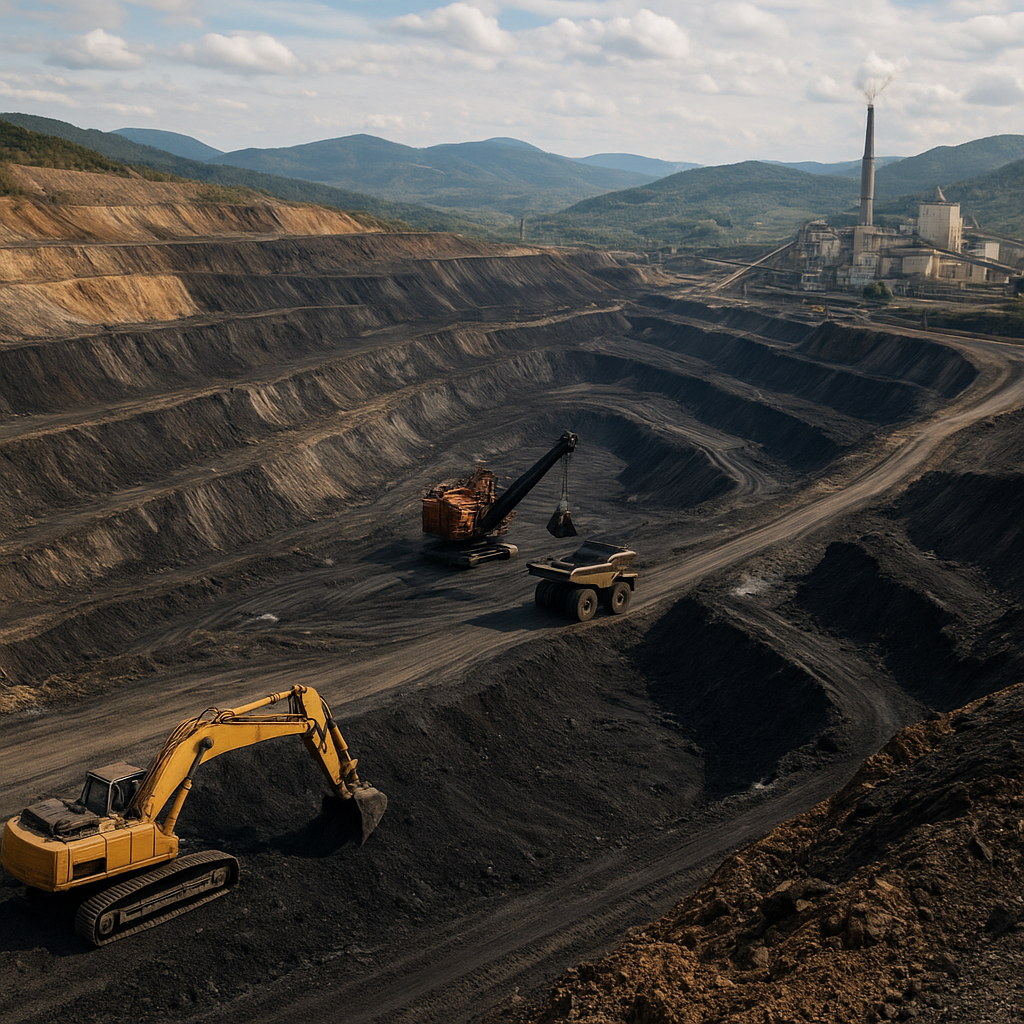
The Richards Bay coal mining and export complex is one of the most important nodes in South Africa’s coal value chain. Located on the northeastern coast of KwaZulu-Natal, the area around Richards Bay hosts a major seaport and export terminal that handles coal from several inland mining regions. This article examines where the coal originates, what types of coal are shipped, the economic and industrial role of the terminal and associated mines, key statistics and logistics, and environmental and social issues associated with large-scale coal mining and export from the region.
Location, geological setting and origin of the coal
Richards Bay itself is a seaport town on South Africa’s east coast, at the mouth of the Mhlathuze River. The coal that passes through Richards Bay is not mined at the harbor; instead, it is sourced from inland coalfields located primarily in the province of Mpumalanga (Highveld, Witbank/Emalahleni, Ermelo and surrounding basins), as well as from deposits in Limpopo and parts of KwaZulu-Natal. These coalfields are part of the greater Karoo and Ecca geological sequences formed during the Permian and Carboniferous periods, producing extensive coal seams that have been mined commercially for over a century.
The coal from these inland basins is transported by rail and road to Richards Bay, where it is screened, blended and loaded onto bulk carriers for international markets. The geology of the source regions yields mostly bituminous coals that are suited to power generation and some coking applications after beneficiation and washing. The quality varies by seam and mine, which makes the port’s stockpiling and blending operations essential for meeting diverse international specifications.
Types of coal produced and quality characteristics
The coal exports handled at Richards Bay are dominated by thermal coal (steam coal) used in electricity generation, both domestically and for export markets. A smaller fraction is higher grade or metallurgical coal suitable for partial coking or blending into steel-making feedstocks, but South Africa’s most significant coal export product is steam coal.
- Calorific value: Export grades typically range from around 4,000 kcal/kg GAR (Gross As Received) for lower-grade shipments to 6,500 kcal/kg GAR for higher-quality export stokes. The most sought-after grades for international power stations are medium to high calorific coals.
- Ash and volatile matter: Ash content and volatile matter differ by seam. Lower ash and higher calorific value coals command premium prices in international markets.
- Sulphur: South African coals generally have low to moderate sulphur concentrations compared with some competing sources, which can be an advantage in markets with sulphur emissions constraints.
- Washability/beneficiation: Many mines operate washing plants to reduce ash and improve calorific value before export. This processing also produces discard streams and tailings that require careful management.
Because of variations in quality between mines, the terminal at Richards Bay plays a critical role in blending coal to achieve contract specifications for shippers and buyers in Asia, Europe and other markets.
Economic and industrial significance
Richards Bay is at the heart of one of South Africa’s largest export industries. The coal exported via the port contributes significantly to national foreign exchange earnings, provincial GDP and employment. Key points of economic significance include:
- Exports: The Richards Bay export complex handles the bulk of South Africa’s seaborne coal exports. This export flow is a vital source of foreign currency and supports the country’s trade balance.
- Employment: Coal mining and the related logistics chain (rail, terminal operations, shipping, and port services) are major employers. Direct mining employment is complemented by thousands of jobs in transport, maintenance, terminal operations and ancillary services.
- Regional development: The inland coalfields and the Richards Bay port drive regional economies in Mpumalanga and KwaZulu-Natal through business opportunities, municipal revenue and infrastructure development.
- Power security: While most of the coal exported is destined for overseas customers, the same mining regions also supply Eskom and industrial users domestically, linking export capacity with national energy security concerns.
Coal export earnings have historically been an important element of South Africa’s economic model. Fluctuations in global coal demand and prices therefore have direct implications for employment and regional fiscal stability.
Infrastructure and logistics: how coal reaches the sea
Transport and port infrastructure are the backbone of the Richards Bay coal export system. Key components include railways, stockyards, conveyor systems and shiploading facilities.
- Rail: Most coal reaches Richards Bay by rail. Transnet Freight Rail (TFR) operates the main freight corridors from Mpumalanga to the Richards Bay terminal. The rail network includes heavy-duty lines built and upgraded to carry long, heavy coal trains that are essential to sustaining high export volumes.
- Stockyards and blending facilities: At Richards Bay, large storage yards and mechanized systems allow for blending of different quality coals to meet contractual specifications. This capability is crucial because it permits consistent product quality despite variability in mine output.
- Terminal operations: The coal terminal is equipped with shiploaders, conveyor belts and dust suppression systems to handle millions of tonnes per year. Efficient shiploading reduces demurrage costs and optimizes turnaround times for bulk carriers.
- Private and public infrastructure: In addition to the main terminal facilities, private coal handling facilities, inland terminals and rail linkages complement the network, offering shippers options and redundancy.
Infrastructure bottlenecks — especially rail availability, rolling stock shortages and scheduling constraints — have at times limited export throughput, highlighting the tight integration required between mining operations, logistics providers and port authorities.
Statistics and recent trends
Exact throughput and export figures fluctuate annually with global demand, local production, infrastructure availability and policy influences. Historically, Richards Bay coal export capacity has been large — with facilities capable of handling tens of millions of tonnes annually. In many peak years, the Richards Bay complex has handled between roughly 60 and 80 million tonnes of coal exports, representing the majority share of South Africa’s seaborne coal exports.
- Export destinations: Major markets for South African export coal include India, various East Asian countries (including China, South Korea and Japan), as well as several European and Middle Eastern buyers. Over the last decade, India has consistently been a leading destination for South African steam coal.
- Price volatility: Global coal prices have experienced significant volatility influenced by demand cycles in Asia, shifts in Chinese import policy, renewable energy competition, and supply-side events (e.g., flooding in major producing regions). Price volatility directly affects mine profitability and investment.
- Throughput trends: Throughput can decline in periods of rail disruption, labour unrest or global demand slumps. Conversely, increased Asian demand or successful infrastructure upgrades can lead to record volumes.
Given the variable nature of global markets, stakeholders—miners, shippers and port operators—closely monitor policy, currency exchange rates and demand signals to adapt export volumes and contractual strategies.
Environmental, social and governance (ESG) aspects
Coal mining and coal export operations have extensive environmental and social implications. These include:
- Environmental impact: Land disturbance, habitat loss, dust emissions, water usage and the risk of acid mine drainage (AMD) from legacy and active mines are major concerns. Coastal terminal operations must also manage coal dust to minimize air and marine contamination.
- Climate change: Coal combustion for power generation is a large source of CO2 emissions; as such, the coal export industry faces long-term demand uncertainty as global energy systems decarbonize. This creates pressure on investors and governments to plan for transitions that reduce reliance on thermal coal.
- Community and labour issues: Employment generated by mines and terminals is beneficial, but the sector also has a history of labour disputes, safety incidents and community tensions related to resource allocation, land rights and environmental impacts.
- Rehabilitation and closure: Post-mining land rehabilitation, mine closure planning and management of tailings and water quality are critical obligations for mining companies, with long-term costs and responsibilities.
Regulatory oversight, corporate sustainability initiatives and community engagement programs are increasingly prominent in managing these risks. International customers also scrutinize supply chains for environmental and social compliance, influencing contract conditions and financing.
Market competition and global context
South African coal exporters, including shipments via Richards Bay, compete with major producers such as Australia, Indonesia and Russia. Competitive factors include:
- Freight costs and distances: Shipping distances to key markets play a major role; Richards Bay is relatively well-positioned for trade with Asia compared with some Atlantic ports, but maritime freight rates influence competitiveness.
- Coal quality: Higher calorific value and lower ash coals generally realize higher prices; competitive positioning can hinge on quality as much as on logistics.
- Policy and trade shifts: Changes in import policies (e.g., China’s periodic restrictions on foreign coal), carbon pricing, and clean energy policies in importing countries shape demand for South African coal.
Despite competition, South African coal retains a niche in several markets due to its reliability, range of available qualities, and the size of the production base that can fulfill large contracts.
Operational challenges and supply chain resilience
The Richards Bay coal export system faces several operational challenges that can affect throughput and reliability:
- Rail and port bottlenecks: Aging rail infrastructure, limited rolling stock and periodic maintenance can create capacity constraints.
- Labour relations: Strikes and labour disputes in the mining and transport sectors have periodically disrupted supply chains and reduced annual exports.
- Logistics coordination: Effective scheduling between mines, rail operators and terminal handlers is essential to avoid congestion, stockpile overflows or ship delays.
- Environmental compliance: Increasing regulatory requirements and community expectations can add operational complexity and costs (e.g., for dust suppression, water treatment and tailings management).
Improving resilience requires coordinated investments in rail upgrades, modernized terminal equipment, improved planning systems and proactive labour and community engagement strategies.
Recent developments and investment trends
Investment in both public and private infrastructure influences the region’s export capacity. Recent years have seen efforts to:
- Upgrade rail corridors to increase train lengths and carrying capacity.
- Enhance terminal handling efficiency through automation, improved stockyard management and environmental controls.
- Develop private coal handling facilities or augment existing terminals to provide shippers with alternative export channels.
- Implement cleaner coal technologies and invest in water treatment and rehabilitation to meet stricter environmental standards.
Such investments aim to reduce per-tonne logistics costs, decrease ship turnaround times and make South African coal more competitive despite global market pressures.
Future outlook and strategic considerations
The future of Richards Bay as a coal export hub will be shaped by multiple strategic forces:
- Global energy transition: Long-term demand for thermal coal is likely to decline in many markets as renewables and gas displace coal-fired generation. However, transitional demand in emerging economies and industrial applications may persist for years, maintaining a role for export hubs.
- Domestic energy policy: South Africa’s energy mix and policy outcomes (including how Eskom’s generation portfolio evolves) will affect both domestic demand and the pace of coal production adjustments.
- Value-add opportunities: There is policy and commercial interest in beneficiation and downstream industries that can extract more value from coal resources (e.g., coal-to-liquids historically, chemicals, or gasification pathways), but these require capital and attract scrutiny over emissions.
- Just transition: The need to manage socio-economic impacts of declining coal demand — safeguarding livelihoods and enabling alternative economic development for coal-dependent regions — is a critical policy challenge.
Strategic planning that integrates economic diversification, infrastructure investment and environmental stewardship will determine how smoothly the region transitions over coming decades.
Interesting facts and lesser-known aspects
- Richards Bay’s coal export complex is one of the largest single-location coal handling systems in Africa, and its scale underpins the logistics efficiencies that make large-volume contracts feasible.
- Blending at terminal stockyards allows exporters to meet very precise calorific and ash specifications demanded by thermal power utilities overseas, effectively making the terminal a quality-control hub.
- Seasonal weather and regional flooding can periodically disrupt inland rail services, underscoring the importance of contingency planning and alternative transport options.
- Environmental management at both mine and terminal levels includes not only dust suppression and water treatment, but also progressive rehabilitation of mined land to reduce long-term liabilities.
Summary
The Richards Bay coal export complex links South Africa’s vast inland coal resources with global markets and plays a pivotal role in the national economy by generating export income, employment and regional development. The coal exported is predominantly thermal coal of varying quality, much of it originating from the Mpumalanga coalfields, moved via heavy-duty rail corridors to the port where the terminal handles storage, blending and shiploading. The entire system’s resilience depends on continued investment in infrastructure, effective supply-chain coordination and responsible environmental and social governance. While global declines in coal demand driven by climate policies present strategic challenges, Richards Bay remains a major coal export hub for years to come, even as stakeholders plan for a gradual energy transition. The convergence of logistics, market dynamics and sustainability considerations will determine how the Richards Bay complex adapts and what role coal exports will play in South Africa’s economy in the next decades.