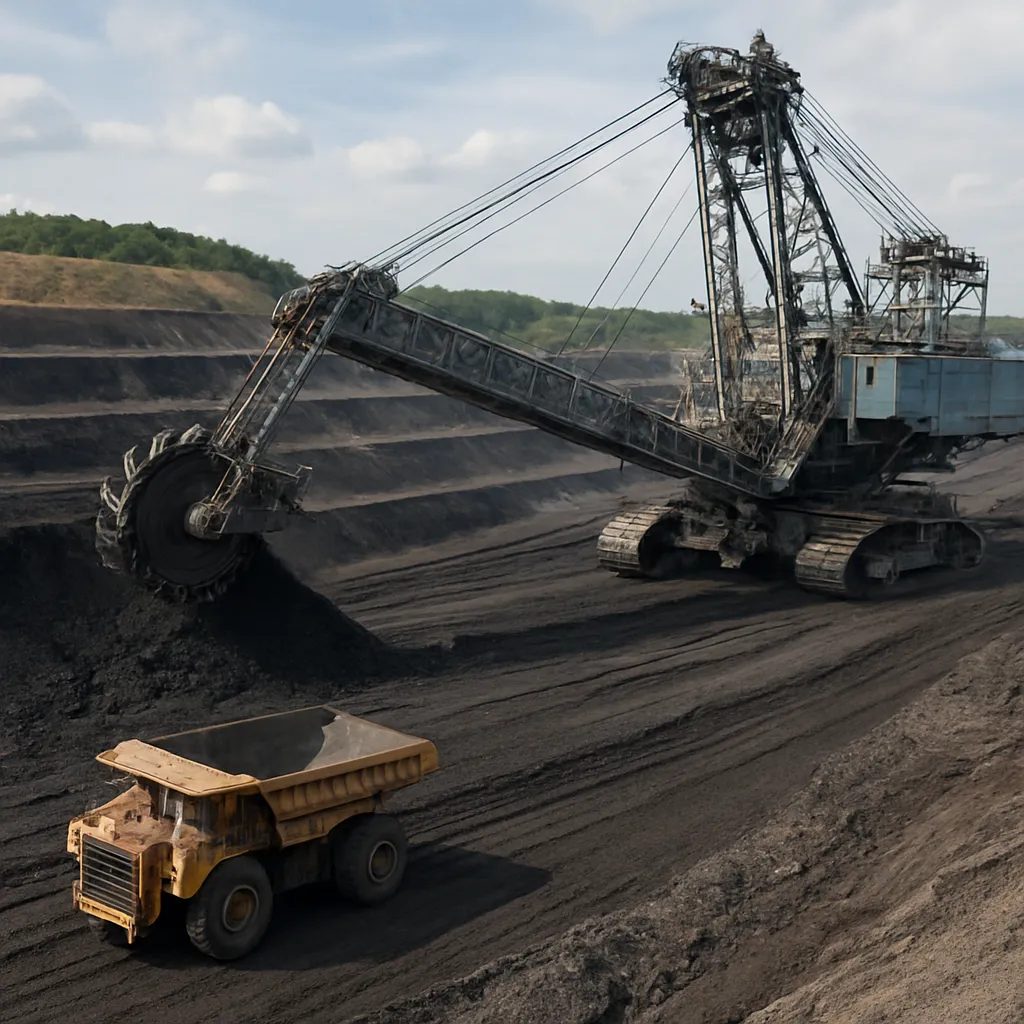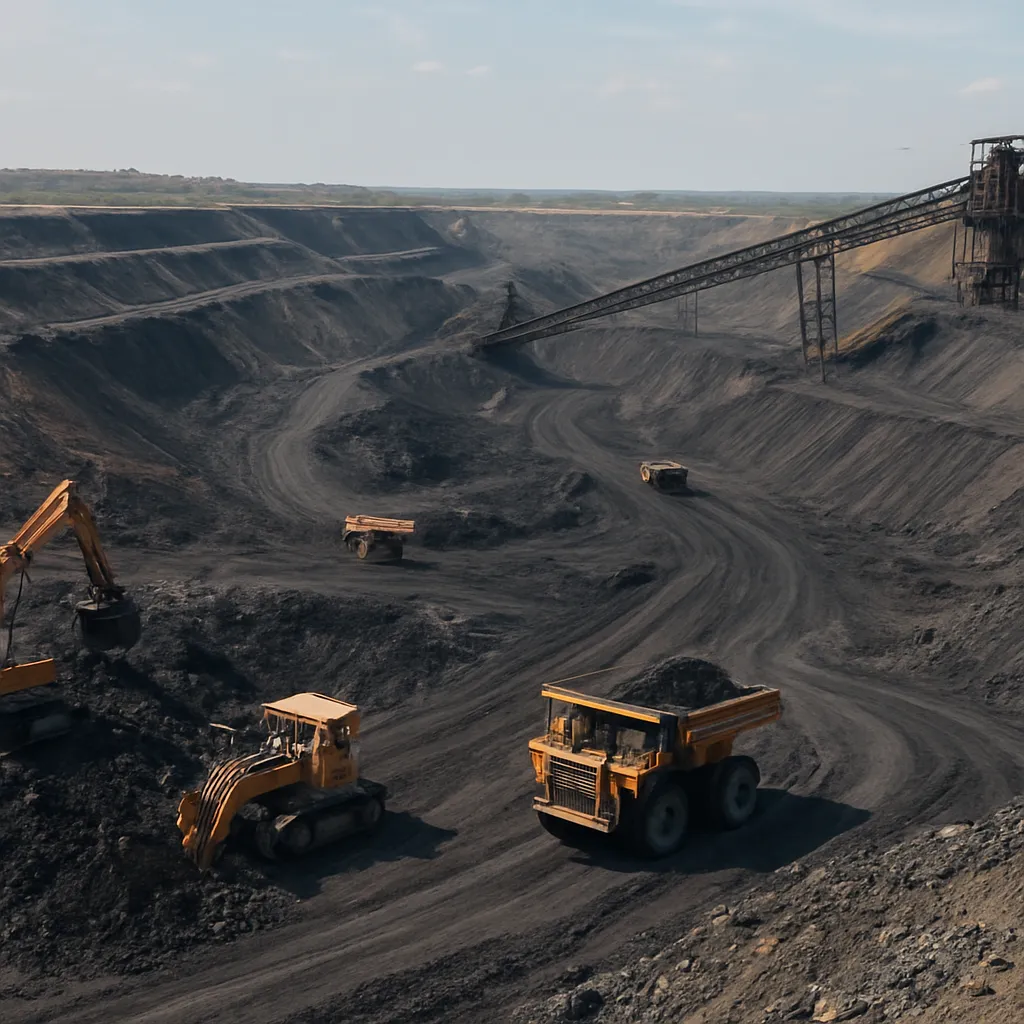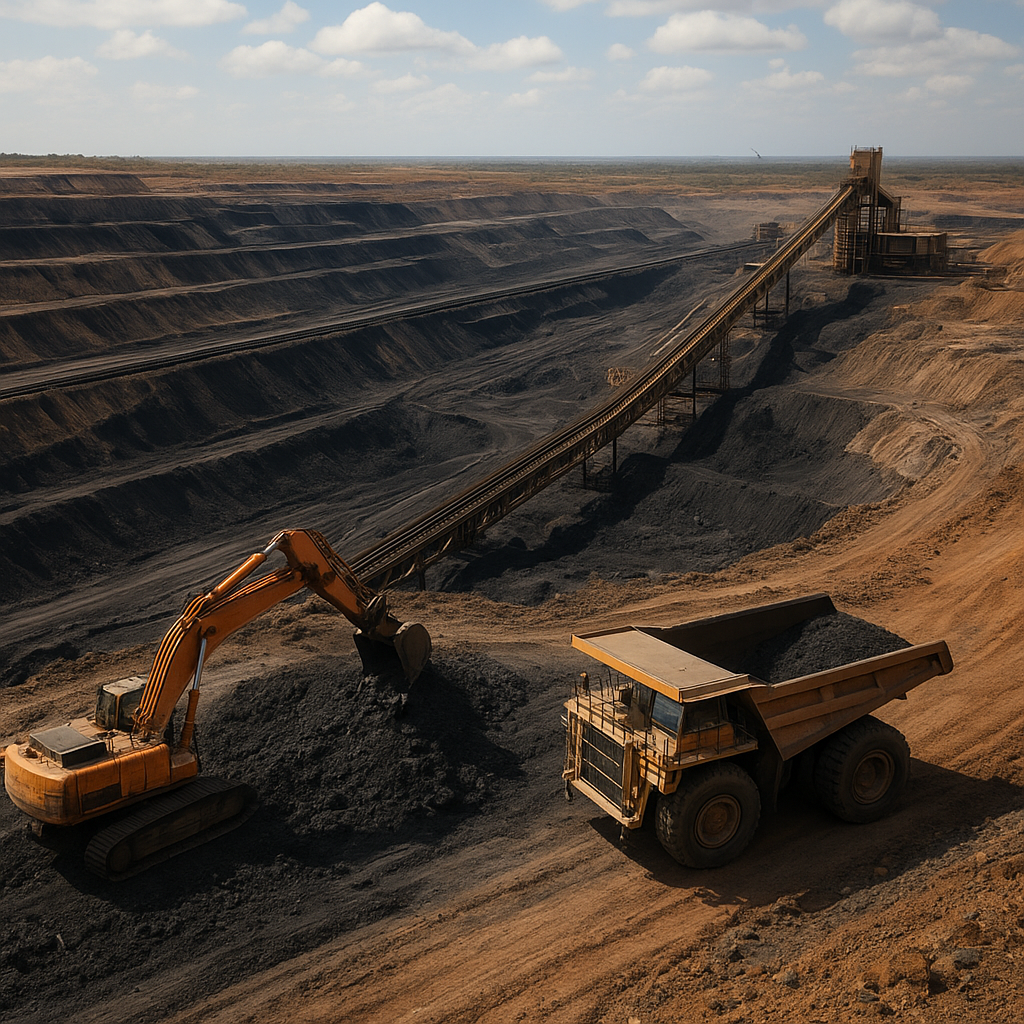
The Carmichael Coal Mine, developed by the Adani Group (operating in Australia through subsidiaries often known locally as Bravus Mining & Resources), is one of the most controversial and closely-watched mining projects of the early 21st century. Located in Queensland’s remote Galilee Basin, the project has attracted global attention for its scale, economic ambitions, environmental risks and the long public and legal battle surrounding its approvals and financing. This article surveys the mine’s location and geology, the type and scale of coal extraction, economic and statistical data where available, the infrastructure and export chains that support it, and the social and environmental debates that continue to define its public profile.
Location, geology and project layout
The Carmichael mine is situated in central Queensland, Australia, roughly between the small towns of Alpha and Clermont (depending on the particular entry point used), in the northern part of the Galilee Basin. The Basin is a geographically extensive but geologically underdeveloped coal province that lies inland from the central Queensland coast. The mine site sits on predominantly flat to gently undulating terrain used historically for cattle grazing.
Geologically, the Galilee Basin contains multiple seams of Permian-aged coal. The Carmichael project targets predominantly thermal coal seams—coal primarily intended for electricity generation rather than metallurgical (steel-making) use. The coal in this part of the Basin is generally characterised as lower rank sub-bituminous to bituminous thermal coal with higher ash and moisture content than some higher-grade coking coals commonly used in steel production. Coal seams in the Basin are thick and laterally extensive, making large bulk extraction technically feasible once infrastructure is in place.
The project includes an open-cut (surface) mine plan, associated waste dumps and water management works, and a dedicated rail link connecting the mine to the port at Abbot Point near Bowen on the Queensland east coast. The port link requires both rail infrastructure and port capacity to handle large bulk exports, including dredging and upgrades at Abbot Point to enable large bulk carriers to load the thermal coal.
Coal characteristics, reserves and production profile
Carmichael’s targeted product is thermal coal for export, primarily intended to serve electricity generation markets, particularly in India. The coal’s chemical and physical properties—higher moisture and ash content than premium export coals—make it lower in calorific value (energy per tonne) compared with some Australian metallurgical coals. Thermal coal from Carmichael is expected to be used in imported-fired power stations or blended with other coals in destination markets.
Estimates of resource and reserve size for the Carmichael deposit have varied across feasibility studies and public statements. Company documents and public reporting have described substantial in-ground resources spanning several hundred million to multiple billion tonnes of coal; however, recoverable reserves (minerally extractable volumes under given economic and technical assumptions) are smaller and depend on staged development and market conditions.
Production targets proposed by the developer have changed through time. Early project proposals and strategic documents discussed the potential for very large scale output (with statements of potential to reach up to tens of millions of tonnes per annum). In practical terms, the mine’s staged development has focused on more modest initial annual production rates (commonly discussed in planning documents in ranges such as around 10–25 million tonnes per annum for initial phases) with the potential to scale in later stages depending on approvals, infrastructure and market demand. A definitive single-year production figure varies by year of operation and by which development phase is active.
Infrastructure, logistics and export routes
A defining element of the Carmichael project is the need for integrated logistics: a dedicated rail corridor to the coast and upgrades to port handling at the Abbot Point terminal. The project’s rail component spans well over 100 kilometres from the mine to the port and required securing land access, approvals and construction of heavy-haul rail suitable for large coal trains.
The export gate for Carmichael coal is the Port of Abbot Point, a bulk coal terminal that required expansion and dredging works to accommodate larger capesize bulk carriers. The port expansion attracted separate environmental scrutiny and regulatory oversight because of its proximity to marine environments that are connected, via currents and ecological pathways, to the Great Barrier Reef World Heritage Area. Once coal is loaded at Abbot Point, shipments are generally destined for Indian power stations as well as other Asian thermal-coal markets.
Given reluctance among several major international lenders and many Australian banks to finance the project, the developer relied on internal financing sources and capital raised from Indian markets and investors, as well as bonds and company loans to fund infrastructure. This financing context influenced the pace of construction and the sequencing of work across mine, rail and port elements.
Economic impacts, employment and regional significance
Proponents of the Carmichael mine emphasised its potential economic benefits at multiple scales. Locally and regionally, the mine promised construction employment, long-term operational jobs, greater local procurement, and increased rates and royalties to state and local governments. Estimates circulated in promotional materials and government statements suggested that the project could generate hundreds to a few thousand jobs during construction and several hundred to over a thousand ongoing positions during operations, including direct roles at mine, rail and port plus indirect jobs in local service industries.
At the state and national level, the project was pitched as a boost to export volumes, foreign-exchange earnings and long-term income from coal sales to growing Asian markets. The developer promoted the mine as a strategic supplier to India’s power sector, linking Australian mining output with Indian energy security and industrial growth.
However, the actual economic legacy is debated. Detractors argue that the number of permanent local jobs is lower than advertised when automation, fly-in fly-out (FIFO) rostering and modern mining practices are considered, and that much of the economic value may be captured by the company and overseas buyers rather than local communities. There are also debates on the long-term viability of thermal-coal investments given global decarbonisation trends, potential carbon-pricing regimes and shifts in investor and lender risk appetites.
Environmental, legal and social controversies
The Carmichael project has been the centrepiece of conflict between economic development interests and environmental and climate-focused groups. Several major strands of concern have featured prominently:
- Climate change: Opponents highlighted that the combustion of exported thermal coal will produce large volumes of carbon dioxide globally, contributing to climate change. Campaigners framed the mine as incompatible with international commitments to limit warming and anathema to global efforts to transition away from fossil fuels.
- Water resources: The mine’s water use and potential impacts on groundwater systems and nearby springs were a major subject of scientific and legal scrutiny. Fears included drawdown impacts on ephemeral streams and groundwater-dependent ecosystems used by local landholders and wildlife.
- Biodiversity and ecosystems: The mine footprint and associated infrastructure could affect native vegetation, threatened species habitat, and regional ecological connectivity.
- Marine impacts and the Great Barrier Reef: Port expansion and dredging to service commodities from the Galilee Basin raised concerns about increased shipping, turbidity and contamination risks in waters that connect to the Reef ecosystem, provoking attention from conservation bodies and UNESCO.
- Indigenous and community rights: Traditional Owners and local communities raised issues about land access agreements, cultural heritage protection and the adequacy of consultation processes.
These environmental concerns translated into extended legal battles in Australian courts and regulatory reviews at both state and federal levels. Multiple nongovernmental organisations and community groups sought to halt or modify approvals through judicial review and public campaigns. The extended timeline of litigation and activism contributed significantly to financial and reputational pressures on the project and the developer.
Financial structure, investment and market context
From its inception, the Carmichael project faced a constrained financing environment. Several major international and Australian banks publicly stated they would not provide project finance due to environmental and reputational risks. As a result, the developer relied more heavily on internal funding from the Adani Group, capital markets in India, and other non-traditional finance routes. This approach included raising project-level debt and equity through Indian financial institutions and bond markets, and using corporate balance-sheet support for construction and early operations.
Capital investment estimates for the mine and associated rail and port works were publicly discussed in the multi-hundred-million to multi-billion Australian dollar range, depending on the scope of works, dredging, rail construction and staging. Exact cost figures fluctuated through planning and early construction phases, reflecting project redesigns, contractual arrangements, and market conditions.
Market conditions for thermal coal have also changed considerably over recent decades. While demand for thermal coal in parts of Asia (notably India, Southeast Asia and parts of China) remained significant through the 2010s and early 2020s, structural trends toward lower-carbon power generation, increased renewables penetration, energy efficiency, and air-quality regulation create long-term uncertainty. Buyers’ preferences and credit conditions increasingly factor in climate-related risk, affecting the long-term pricing and demand prospects for new thermal-coal projects.
Statistics, milestones and operational status
Key milestones in the Carmichael project’s timeline include:
- Early exploration and feasibility work in the 2010s identifying substantial coal resources in the Galilee Basin.
- State and federal environmental approvals in the mid-2010s after extensive assessment and conditional permits (with critical legal challenges ensuing afterwards).
- Years of litigation, public protests and financing scrutiny that delayed the progression from approval to construction for much of the late 2010s.
- Start of major construction works and staged commissioning of mine and rail infrastructure in the late 2010s to early 2020s, with first commercial shipments reported in late 2021 and 2022 as the project moved toward operational phases (timing varied by source and activity stage).
Reported employment figures during construction and operation have varied by public statement and stage. Developer materials and regional government commentary commonly referenced several hundred to a few thousand direct jobs during construction, and several hundred permanent operational roles during steady-state operations, with many additional indirect jobs in supply and services.
Production and export volumes depend on the year of operation and the particular phase. Early operational years focused on ramping up volumes and settling logistics, while full-stage production—if pursued—would align with the developer’s staged expansion strategy and market demand.
Broader significance and lessons
The Carmichael mine has become more than a single resource development; it is a case study in how large fossil-fuel projects are assessed, financed and contested in the 21st century. The project illustrates several broader points:
- Governance and regulation: The need for robust, transparent environmental assessment processes that can withstand public scrutiny and legal challenge.
- Investor and lender behaviour: How reputational and climate risk considerations influence capital markets and constrain traditional project finance.
- Community and Indigenous engagement: The importance of meaningful consultation and benefit-sharing with local and First Nations communities.
- Energy transition dynamics: The tension between short- to medium-term energy demand in developing economies and long-term climate commitments, which complicates planning for large-scope thermal-coal projects.
Other notable facts and context
Cultural and political responses to the project have ranged from local support among groups anticipating jobs and regional investment to national and international criticism focused on climate and biodiversity impacts. High-profile protests, including extended on-site blockade campaigns and court-based legal actions, attracted global media and galvanised broader debates about financing and the ethics of exporting fossil fuels to meet the energy needs of fast-growing economies.
Operationally, the mine has acted as a test of the logistical model connecting a large inland thermal-coal deposit via dedicated rail to an upgraded export terminal on the Queensland coast. The integrated-chain nature of the development—mine, rail, port—meant that delays or constraints in one link could affect the whole project’s economics.
From an investor perspective, Carmichael has served as an example of a company pursuing project delivery despite limited external bank appetite by mobilising internal group resources and alternative domestic capital. For climate and conservation advocates, the project exemplified the risks of new coal supply in an era where many governments and companies are signalling decarbonisation trajectories.
Conclusion
The Carmichael Coal Mine remains one of Australia’s most discussed mining projects due to its scale, the international profile of its developer, its proximity (in ecological and political terms) to sensitive marine areas, and the broader implications for climate policy and Australian resource exports. The mine produces thermal coal from the Galilee Basin, exports via Abbot Point, and has been financed and developed amid strong public debate. Its legacy will be judged not only by tonnes exported or jobs created but also by how the long-term environmental, social and economic trade-offs are managed in a world moving toward lower-carbon energy systems.