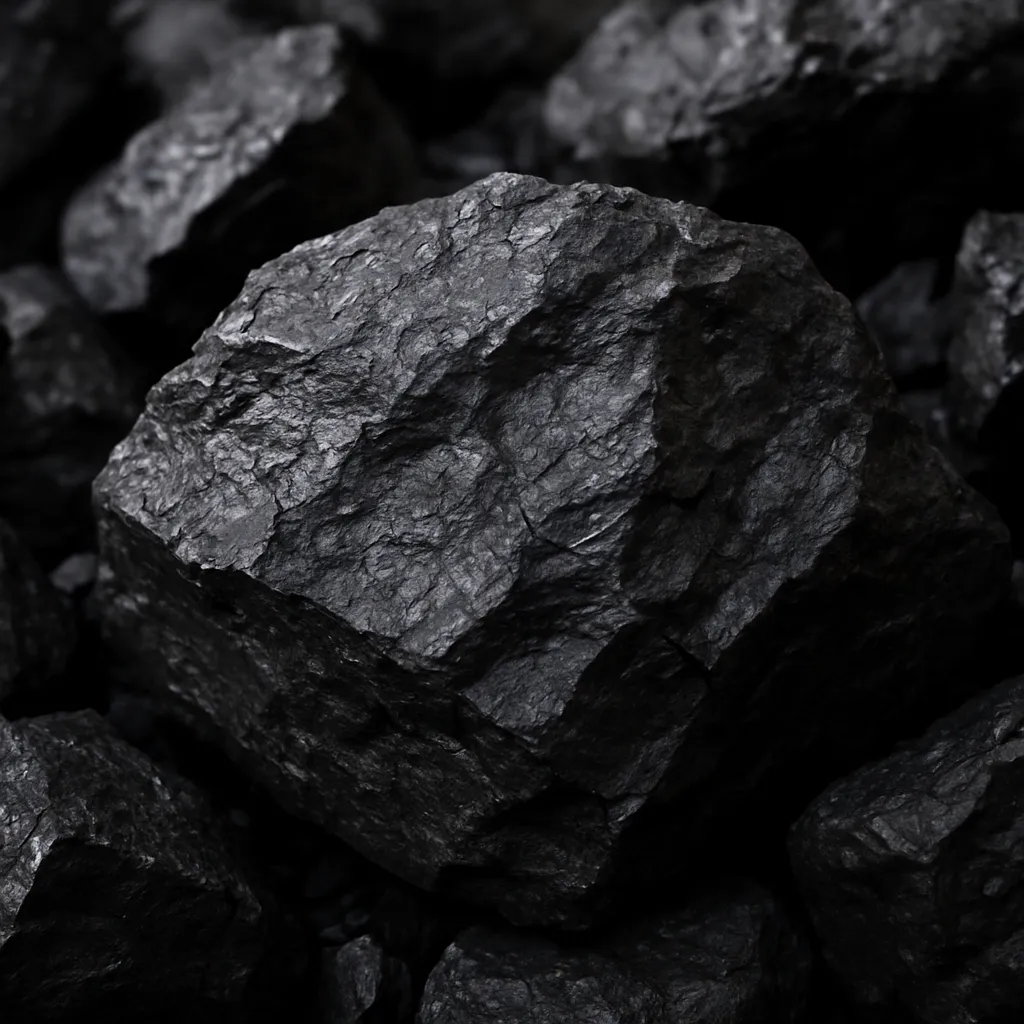
Non-coking coal, often referred to as thermal or steam coal, is one of the most widely used fossil fuels in the world. Unlike coking coal, which is suitable for metallurgical processes such as steelmaking, non-coking coal is primarily used to generate electricity and heat. This article examines the geology and global distribution of non-coking coal, where it is mined, its economic and trade dynamics, its role in industry, environmental and technological issues, and statistical trends shaping its future. The aim is to provide a comprehensive overview that is both practical and informative for readers interested in energy, mining, and global resource economics.
Occurrence, types and geology of non-coking coal
Coal is classified by rank (lignite, sub-bituminous, bituminous, anthracite) and by its intended uses. Non-coking coal spans several of these ranks, but is generally characterized by properties that make it unsuitable for coke production: lower volatile matter composition and different bonding properties in the coal matrix. The main categories relevant to non-coking coal are:
- Bituminous thermal coal — common in many basins, relatively high heating value, used extensively in power generation.
- Sub-bituminous coal — lower density and heating value than bituminous, often used near the mine due to higher moisture content.
- Lignite (brown coal) — lowest rank, highest moisture, used for near-mine power plants and district heating.
Geologically, coal forms in sedimentary basins from the accumulated remains of vegetation in anaerobic, swampy environments. Over geological time, pressure and temperature transform peat into coal. Non-coking coals are found in both older, deeply buried formations and in younger, near-surface deposits. Important geological controls on non-coking coal quality and distribution include the original peat composition, degree of burial (rank), tectonic setting, and subsequent weathering.
Global distribution and major mining regions
Coal resources and production are concentrated in several major regions. A relatively small number of countries dominate both production and reserves. The world’s recoverable coal reserves are large: estimates put proven reserves at roughly around 1.1 trillion tonnes, distributed unevenly between countries. Large basins in North America, Eurasia, Asia-Pacific, and parts of Africa host the bulk of these reserves.
- China: The largest producer and consumer of coal, producing nearly half of global output. China’s coal ranges widely in rank and quality and supplies its vast fleet of coal-fired power plants and industrial users.
- India: A major producer and rapidly growing consumer—India relies heavily on non-coking coal for electricity and industry.
- United States: One of the largest producers with substantial reserves of sub-bituminous and bituminous coal, used domestically for power and exports.
- Australia and Indonesia: Key exporters, with Indonesia notable for seaborne sub-bituminous thermal coal and Australia producing large volumes of high-quality thermal coal for the global market.
- Russia: Large reserves and substantial production serving domestic markets and export corridors into Europe and Asia.
- Other producers: South Africa, Colombia, Poland, Kazakhstan, and Turkey also contribute meaningful volumes, primarily for domestic consumption or regional trade.
Large sedimentary basins such as the Powder River Basin (USA), Bowen Basin (Australia), Dhanbad and Jharia regions (India), and the Shanxi and Inner Mongolia basins (China) are examples where non-coking coal is extensively mined. Lignite deposits are also important in parts of Germany, Poland, and Greece for nearby power generation and heating.
Mining methods and production practices
Non-coking coal is extracted using both surface (open-pit) and underground mining. The choice depends on geology, depth, seam thickness, and economic considerations.
- Surface mining: Widely used for shallow, thick seams. It is cost-effective and accounts for a large share of global thermal coal production, especially in regions like Australia and the Powder River Basin in the US.
- Underground mining: Employed where seams are deeper. Techniques include longwall and room-and-pillar mining. Underground operations are more capital- and labor-intensive and often serve older basins in China, Poland, and parts of Russia.
- Seam preparation and beneficiation: Many thermal coals undergo washing and sorting to lower ash and sulfur content and improve calorific value for transport and combustion efficiency.
Transportation logistics are crucial because non-coking coal is typically bulky and often used near large power plants or transported on bulk shipping routes when exported. Rail, conveyor belt systems, river barges, and ocean bulk carriers (capesize, panamax) are central to coal logistics. Export hubs such as Newcastle (Australia), Richards Bay (South Africa), and ports in Indonesia and Russia are strategically important for global coal flows.
Economic and trade aspects
Non-coking coal is central to energy economics in many countries because it remains an affordable and reliable fuel for base-load electricity generation. The economics of thermal coal are influenced by:
- Domestic demand for electricity and industrial heat.
- Government energy policy, including subsidies, tariffs, and environmental regulation.
- Global trade flows and freight costs.
- Price volatility on international thermal coal benchmarks such as the Newcastle index in Australia and the ARA (Amsterdam–Rotterdam–Antwerp) index for European coal.
Major exporters — notably Indonesia and Australia — compete on price and logistics. Seaborne thermal coal trade typically moves around one billion tonnes per year, although the precise figure changes with demand cycles and economic conditions. Large importers such as China, India, Japan, South Korea, and several European countries shape market dynamics. For many developing economies, imported thermal coal is a cheaper way to secure reliable energy than some alternatives.
Price volatility can be significant. Events such as supply disruptions, geopolitical conflicts, changes in shipping costs, or sudden shifts in demand (for example, unusually cold winters or strong economic growth) can cause rapid price swings. In addition, policy signals related to decarbonization and carbon pricing add uncertainty for long-term investments in coal projects.
Industrial uses and significance
The primary industrial role of non-coking coal is in power generation. Beyond electricity, thermal coal supports several other activities:
- District heating and industrial process heat in cement, paper, and chemicals industries.
- Coal gasification and liquefaction projects in countries pursuing synthetic fuels or chemicals (coal-to-liquids, coal-to-chemicals), although these are capital-intensive and carbon-intensive.
- Residential and commercial heating in some regions where alternatives are limited.
- Pulverized coal injection (PCI) into blast furnaces — while not a coking coal use per se, certain thermal coals can be used to supplement metallurgical coke in steelmaking processes.
Thermal coal underpins grid stability in many countries by providing predictable base-load power complementing intermittent renewable generation. In regions with limited access to natural gas or expensive gas infrastructure, coal remains a key fuel for reliable electricity.
Environmental impacts and mitigation
Non-coking coal is associated with significant environmental and public health concerns. Combustion emits carbon dioxide (CO2), particulate matter, sulfur oxides (SOx), nitrogen oxides (NOx), mercury, and other pollutants. Large-scale coal use contributes to air pollution and climate change. Key mitigation measures and technologies include:
- End-of-pipe controls: flue gas desulfurization, selective catalytic reduction (for NOx), and electrostatic precipitators or fabric filters (for particulates).
- Efficiency improvements: higher-efficiency coal-fired power plants (supercritical and ultra-supercritical boilers) reduce CO2 per unit of electricity.
- Fuel switching and co-firing: blending biomass with coal to reduce net CO2 emissions.
- Carbon capture, utilization and storage (CCUS): capturing CO2 from flue gases and storing it underground or using it industrially. CCUS is technically promising but faces cost and scale-up challenges.
- Reclamation and remediation: restoring mined lands, treating acid mine drainage, and managing mine tailings.
Policy pressures—such as carbon pricing, emission standards, and commitments under international climate agreements—are pushing many countries to reduce coal consumption. This has prompted early retirements of coal plants in parts of Europe and North America, but in some Asian markets, coal-fired generation is still growing due to energy security and development needs.
Statistical snapshot and market trends
While detailed numbers vary year to year, several broad statistical patterns are evident:
- Global coal production: Roughly on the order of 7–8 billion tonnes of hard coal and lignite annually in recent years, though annual output fluctuates with demand and economic cycles.
- Share in electricity generation: Coal has historically supplied about one-third to two-fifths of global electricity generation, making it the largest single source of power in many years. In 2021–2022, coal’s share hovered in that range, with year-to-year differences driven by fuel switching and renewable growth.
- Top producing countries: China accounts for a large share (approaching half) of global coal production; India, the United States, Australia, and Indonesia are important producers as well.
- Seaborne trade: International trade in thermal coal is substantial but smaller than total production, typically in the range of around one billion tonnes annually for thermal coal on seaborne markets. Maritime exporters include Australia, Indonesia, Russia, the United States, and Colombia.
- Reserves: Proven global coal reserves are substantial—on the order of a trillion tonnes, with large concentrated reserves in the United States, Russia, China, Australia, and India.
Market dynamics in the 2010s and early 2020s have been shaped by several forces: the expansion of renewables, environmental regulation, energy security concerns, and geopolitical events. For example, disruptions to energy supplies or rapid economic rebounds can cause spikes in coal demand and prices, while policy-driven retirements or the expansion of affordable gas and renewables can depress demand. Price indices such as the Newcastle benchmark and the ARA index are commonly used to reference international thermal coal prices, and they demonstrate volatility across economic cycles.
Future outlook and strategic considerations
The mid- to long-term outlook for non-coking coal is uncertain and regionally differentiated. Several factors will shape its trajectory:
- Energy transition and climate policy: Stronger commitments to decarbonization will reduce the role of coal in many economies, especially where alternatives are economically viable.
- Economic development and electrification: In growing economies where rapid electrification is a priority, thermal coal may retain a role for decades, particularly where renewable capacity and grid upgrades lag or where gas is scarce.
- Technological change: Advances in CCUS, higher-efficiency coal plants, and hybrid systems could extend coal’s viability with lower emissions, but cost and deployment scale are critical hurdles.
- Supply security and geopolitics: In some regions, coal remains a strategic asset for energy independence. Disruptions in global supply chains (e.g., maritime chokepoints) can reorient trade flows and pricing.
Investors and policymakers face trade-offs: managing transitions to cleaner energy while ensuring affordable and reliable electricity. For countries with large domestic coal reserves and limited alternatives, the pathway will likely emphasize improved environmental controls, efficiency gains, and exploration of CCUS, at least in the near- to medium-term.
Interesting technical and socioeconomic facts
Several lesser-known but important aspects of non-coking coal are worth highlighting:
- Quality variation: Thermal coals vary widely in calorific value (often expressed in MJ/kg or kcal/kg), ash content, sulfur, and moisture. These properties determine suitability for specific plants and influence shipping economics.
- Role in peaking vs base-load: While coal traditionally serves base-load, modern coal plants can provide flexibility to some extent, helping balance grids with variable renewables.
- Coal and employment: In many coal regions, mining is a major employer and source of local revenue, which complicates rapid transitions due to social and economic impacts on communities.
- Co-benefits and risks of modernization: Retrofitting plants with emissions controls significantly reduces local air pollution and health impacts, but the capital cost is often a barrier.
Concluding perspective
Non-coking coal remains a dominant fuel in many parts of the world because of its abundance, relatively low cost, and role in providing reliable heat and power. Globally, the resource base is large enough to support continued use for decades, but the balance between energy access, economic development, and environmental goals is driving substantial change. In advanced economies, coal is being displaced by renewables and gas, while in several developing regions it continues to support growth and electrification. How quickly technologies like CCUS scale and how governments design policy incentives will largely determine whether non-coking coal’s role is sustainable in a low-carbon future or becomes rapidly marginalized.