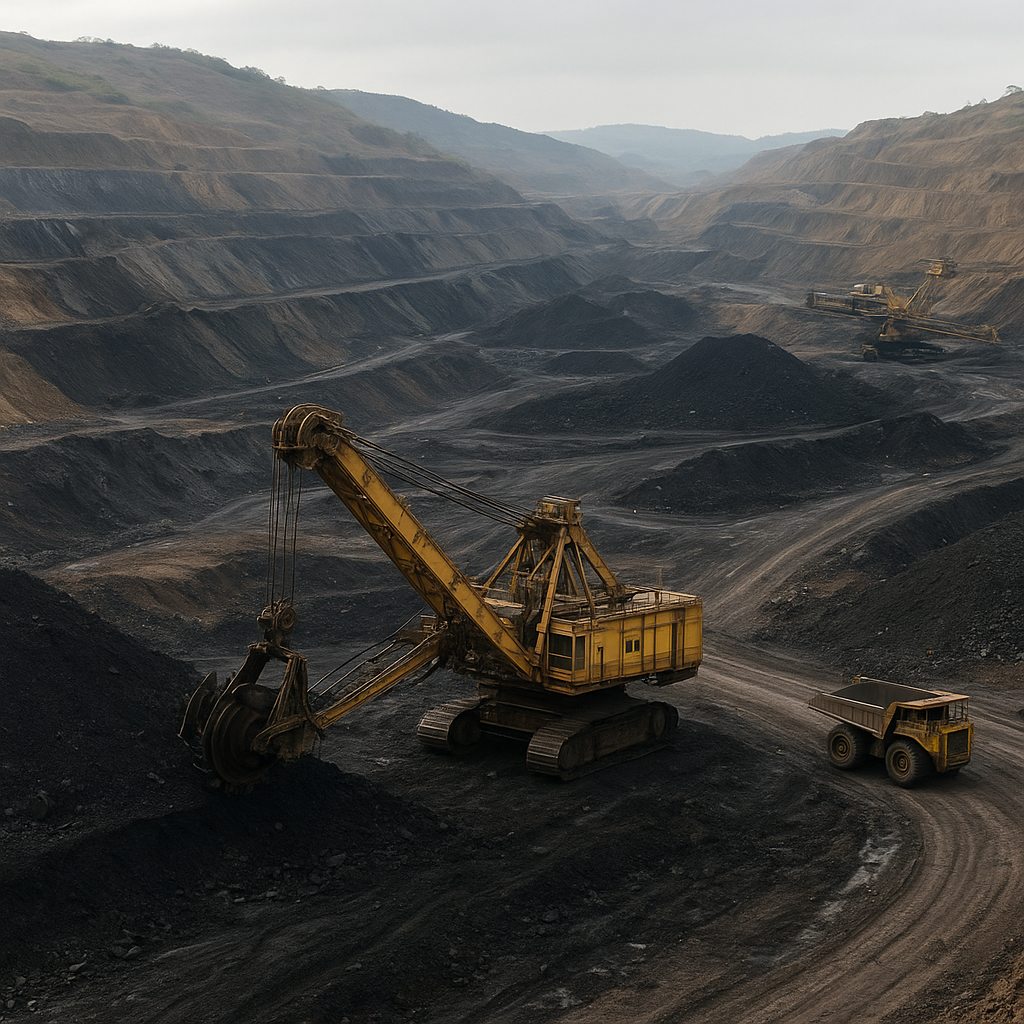
The Kusmunda Mine is a prominent coal mining complex in central India whose operations, geology and local economic impact make it an important node in the country’s energy and industrial map. Located in the Korba coalfield region of Chhattisgarh and operated under the aegis of one of India’s major coal-producing enterprises, the mine supplies coal mainly for power generation and local industry, while also raising complex questions about environmental management, land use and the future of thermal fuel markets. This article examines the mine’s location and geology, mining methods and infrastructure, production and economic importance, environmental and social issues, and prospects for the coming decades.
Location, geological setting and history
The Kusmunda Mine lies in the Korba coalfield area of the Indian state of Chhattisgarh, within Korba district, a region long recognized as one of India’s principal coal-bearing basins. The mine forms part of the broader mining portfolio of South Eastern Coalfields Limited (SECL), a subsidiary of Coal India Limited, which operates multiple large opencast and underground mines in this part of central India.
Geologically, Kusmunda exploits seams within the Permian Gondwana strata typical of central Indian coalfields. The coal seams are dominated by medium- to high-ash, bituminous (non-coking) coal that is principally suited for thermal power generation and certain industrial uses. The coal-bearing sequence includes multiple seams of variable thickness, with overburden characteristics that allow the application of large-scale surface mining techniques. Historically, the Korba coalfield—of which Kusmunda is a part—expanded rapidly during the post-independence period to feed rapidly growing thermal power capacity in the region and nationwide electrification programs.
Key geological and historical points
- Coal type: Predominantly non-coking, bituminous coal with relatively high ash content compared with some other Indian coalfields.
- Stratigraphy: Typical Gondwana sequence with multiple minable seams; seam thickness and continuity enable large-scale opencast development.
- Historical role: Developed to supply nearby power stations and industries; expansion was driven by demand from thermal power plants in Korba and adjoining regions.
Mining methods, infrastructure and technology
Kusmunda is primarily known as a large-scale opencast mine. Opencast mining methods permit high-volume extraction using heavy earthmoving equipment, draglines, shovel-truck fleets and extensive conveyor systems. The mine layout typically comprises a sequence of benches, large waste dumps (overburden dumps), coal stockyards, and access roads. Modern operations emphasize mechanization to improve productivity and safety, combined with surface-to-plant logistics (conveyors, rail links and road transport) to deliver coal to consumers.
Key components of mining and logistics at Kusmunda include:
- Large-scale excavation equipment (shovels, hydraulic excavators, dump trucks and, in some phases, continuous miners or bucket wheel reclaimers).
- Conveyor networks and rail sidings to transport coal to nearby thermal power stations and to broader rail distribution networks for longer-distance supply.
- On-site coal handling and sorting facilities, including screening and, where applicable, washery facilities that improve coal quality by reducing ash content.
- Mine planning and geology teams that manage pit sequencing, slope stability, dewatering and progressive reclamation initiatives.
Technological modernization at large SECL mines like Kusmunda has included GPS-based fleet management, real-time monitoring of production metrics, and gradual adoption of automation and safety-management systems. These improvements aim to raise extraction efficiency, reduce downtimes, and enhance occupational safety.
Production, reserves and statistical profile
Exact figures for annual production and remaining reserves can fluctuate by year and by the source reporting them. Kusmunda is regarded as one of the sizable mines within the Korba field, contributing millions of tonnes of coal annually to meet regional demand. The coal is primarily destined for thermal power plants—both state and central sector utilities—and other industrial consumers in the region.
Reported and estimated statistical highlights (indicative):
- Production capacity: The mine complex has historically reported an annual production in the low-to-mid millions of tonnes range. Annual throughput can vary year to year depending on expansion projects, equipment availability and demand from power plants.
- Reserves: Recoverable reserves are commonly expressed as several hundred million tonnes when considering the broader cluster of pits in the Kusmunda area; the specific proved and probable figures depend on the latest surveys and are periodically updated by SECL and Coal India Limited.
- Coal quality: The coal from Kusmunda generally has moderate calorific value suitable for power stations, with relatively high ash content compared with imported coal; washery operations can improve quality for select customers.
- Employment and workforce: The mine supports a sizeable workforce including direct mine employees, contractors (equipment operators, maintenance staff), and ancillary services, numbering in the thousands when combined with associated infrastructure and logistics operations.
Because mines within the Korba complex operate in an integrated manner—sharing logistics, rails and buyer relationships—production statistics from a single pit should be interpreted as part of a system-wide output. SECL and Coal India publish periodic production and reserve reports that detail yearly performance; those company documents are the definitive source for precise numeric values at any given point in time.
Economic significance and industrial linkages
The economic importance of Kusmunda for the local and regional economy is multi-faceted. Coal from Kusmunda supplies thermal power plants that provide baseload electricity to industries, urban centers and rural electrification projects. The mine’s operations contribute directly through wages, procurement of goods and services, and indirectly through royalties and taxes paid to state and central governments.
Major economic impacts include:
- Power sector support: The mine is a pool of fuel for nearby power stations, contributing to energy security for Chhattisgarh and neighboring states.
- Employment: Direct and indirect job creation in mining, transport, equipment maintenance, contract services and supplier sectors.
- Local development: Royalties, CSR (corporate social responsibility) programs and logistical investments such as roads, medical facilities and schools that often accompany major mining operations.
- Industrial feedstock: Beyond power, coal supports cement, sponge iron and other energy-intensive local industries.
From a macro perspective, Kusmunda and similar mines in the Korba area help sustain the regional industrial cluster that emerged around reliable coal supply. This cluster amplifies economic activity by attracting energy-intensive industries that rely on competitively priced domestic coal.
Social and environmental considerations
Large opencast mines inevitably raise significant environmental and social challenges. Kusmunda’s operations have been associated with land acquisition, displacement of communities, changes in local land use patterns and ecological disruption. Addressing these concerns has involved statutory requirements for rehabilitation, compensation, afforestation, and pollution control measures.
Key environmental and social issues include:
- Land and displacement: Opencast expansion often requires acquisition of agricultural and forest lands, leading to relocation and livelihood changes for affected households. Compensation and resettlement plans are part of the legal framework but implementation quality varies.
- Air and water pollution: Dust from blasting, excavation, coal handling and transport contributes to local air quality issues. Runoff and mine dewatering can affect local water tables and water quality if not managed properly.
- Waste management: Overburden dumps, fly ash from power plants and process rejects from washeries require long-term engineering and rehabilitation to avoid erosion, leaching and habitat degradation.
- Biodiversity impacts: Clearing of forest and scrubland for mining affects fauna and flora; progressive reclamation and plantation programs are used to mitigate these impacts.
- Occupational safety: Mining carries risks of accidents, equipment-related injuries and health issues from dust exposure; improved safety protocols and monitoring are continual priorities.
In response to regulatory and community pressures, operators including SECL deploy a range of mitigation measures: progressive backfilling and reclamation of exhausted pits, creation of green belts, air-suppression systems (water sprinklers, covered conveyors), installation of effluent treatment plants, and socially oriented programs for displaced communities (skill training, livelihood support and infrastructure development).
Role in energy transition and future prospects
The future of Kusmunda must be viewed in the context of India’s broader energy transition. India continues to rely heavily on coal for baseload power, even as renewables, energy efficiency and policy drives aim to diversify the energy mix. Mines such as Kusmunda will likely play an important near- to medium-term role in supplying coal for power and industry, while facing evolving regulatory, environmental and market pressures.
Factors shaping Kusmunda’s future:
- Demand dynamics: Domestic demand for thermal coal from power plants and industry will determine throughput. Upgrades in power plant efficiency and the commissioning or retirement of thermal units influence demand.
- Policy and regulation: Stricter environmental norms, emissions standards, and mine rehabilitation rules will affect operational costs and investments needed to remain compliant.
- Technological modernization: Adoption of more efficient mining fleets, electrification of equipment, digitization of operations and advanced washery processes can lower unit costs and environmental footprint.
- Diversification and mine closure planning: Over time, operators must plan for progressive reclamation, alternative land uses for exhausted pits (water bodies, afforested areas, solar parks) and socio-economic transitions for the workforce and local communities.
Innovations such as coal gasification, coal-to-chemical pathways, or integrated projects that use mine voids for pumped-storage hydropower or solar installations are being explored in various coal-mining regions; similar ideas may be considered for post-mining land uses in Kusmunda depending on feasibility and policy support.
Interesting facts and contextual observations
- Kusmunda operates within one of India’s most industrialized coal belts, and its fortunes are closely tied to nearby large thermal power stations and industrial consumers.
- The mine illustrates the dual nature of coal in India’s economy: a critical source of affordable energy and industrial feedstock, but also a focal point for environmental and social challenges that accompany extractive development.
- Large open pits become visible landmarks in the landscape, and progressive reclamation has the potential to transform former mining areas into community assets—if planning and funding align.
- Employment patterns in and around the mine reflect both formal direct employment and a sizable informal labor market supporting logistics, catering, and other services.
Concluding perspective
Kusmunda Mine is an important element of India’s coal-mining infrastructure with significant implications for local economies, regional industrial supply chains and national energy security. The mine’s value derives from its capacity to provide bulk coal for thermal power generation and industry, to generate employment, and to underpin a cluster of ancillary economic activity in the Korba region. At the same time, Kusmunda exemplifies the environmental and social trade-offs of large-scale surface mining: land use changes, ecosystem impacts and the need for careful rehabilitation and community engagement.
Going forward, the trajectory of Kusmunda will be determined by a mix of market demand for domestic coal, regulatory pressures to reduce environmental impacts, investment in operational efficiencies and the ability of stakeholders—government, company and community—to plan for the social and ecological legacy of mining. With thoughtful management and technological upgrades, the mine can sustain its economic role while progressively reducing adverse impacts and preparing the region for a post-mining future.


