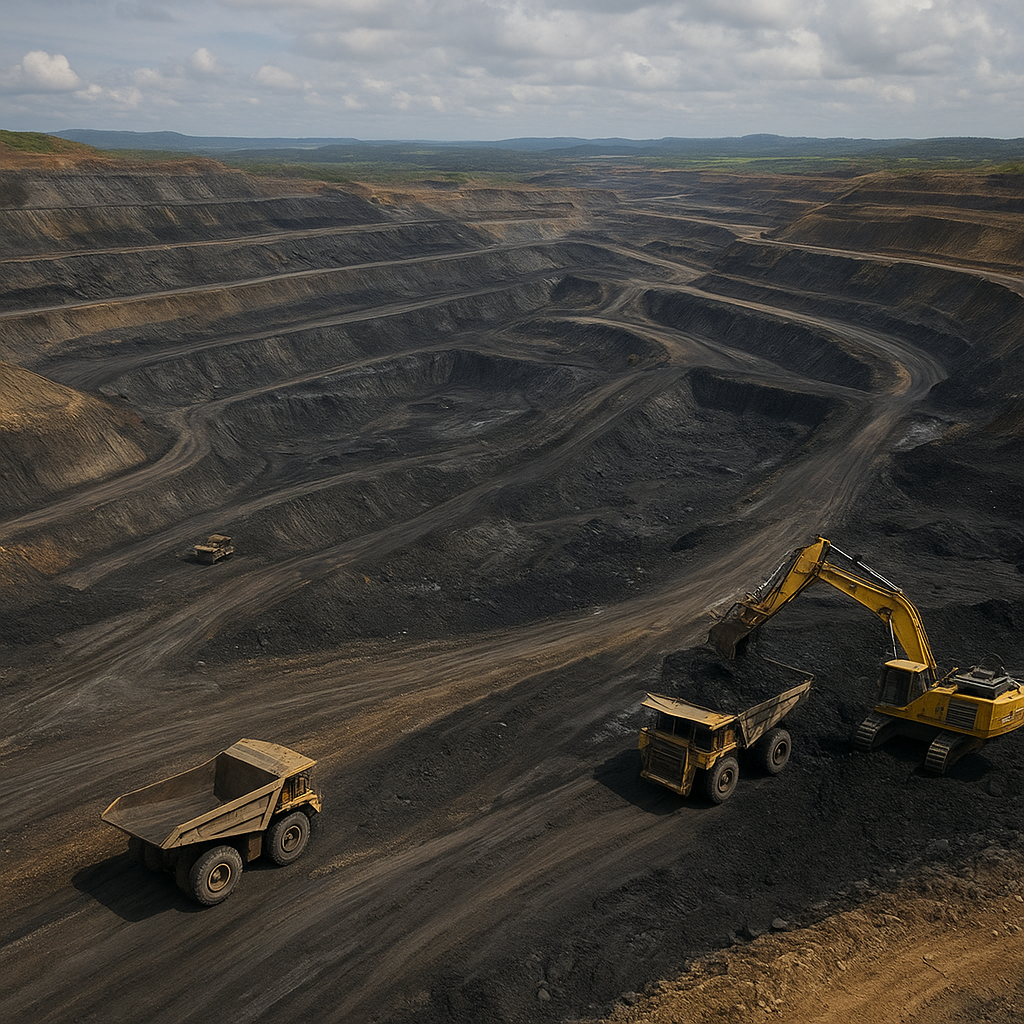
The following article presents a comprehensive overview of the Amlohri Mine, a coal mining site in India. Publicly available, mine-specific data for Amlohri are limited; therefore the narrative combines verified patterns from India’s coal sector, technical descriptions, and reasonable inferences about a typical medium-sized coal operation in the region. The article covers geological setting, the type of resource extracted, economic and industrial roles, environmental and social aspects, infrastructure and logistics, and future prospects. Key terms and concepts are highlighted to facilitate rapid reading and emphasis on priorities.
Location and geological setting
The Amlohri Mine is located within the broader Indian coal-bearing provinces that extend across eastern and central India. While smaller mines like Amlohri are often nested in larger coalfields, their exact administrative details may vary over time as leases, company ownership and operational boundaries change. Typically, mines in this region are found in states such as Jharkhand, Chhattisgarh, Odisha, and parts of West Bengal, forming part of India’s extensive continental coal basins.
Geologically, the coal seams exploited by mines similar to Amlohri tend to belong to the Permian and Gondwana sequences, which are the primary source of commercial coal in India. These sequences yield predominantly bituminous and sub-bituminous coals. The stratigraphy is often characterized by multiple seams of variable thickness, interbedded with sandstones, shales and occasional clay bands. Seam thickness, depth, and inclination determine whether the deposit is exploited by surface (open-cast) or underground mining methods.
Typical coal properties found in the region
- Calorific value: ranges from low to medium-high for Gondwana coals (commonly between 3,000 and 6,000 kcal/kg in many deposit zones).
- Rank: generally bituminous to sub-bituminous, suitable primarily for thermal power generation; higher-grade coals for metallurgical use are less common.
- Moisture, ash and sulfur: variable; many Indian coals have higher ash content compared with some international benchmarks, influencing handling and combustion efficiency.
What is extracted and mining methods
The primary commodity at the Amlohri Mine is coal, targeted for either local power plants, regional industries, or national supply chains. The precise variety and quality depend on seam characteristics, but the operational profile of similar mines typically includes:
- Extraction of thermal coal largely destined for electricity generation.
- Occasional recovery or blending for industries (cement, bricks, small metallurgical applications) where appropriate.
Mining methods reflect seam depth and overburden characteristics:
- Open-cast (open-pit) mining: applied where seams are near-surface and overburden removal is economical. It yields higher tonnages, lower unit costs, and faster ramp-up.
- Underground mining: used where seams are deep, steeply inclined, or conservation of surface land is required. Methods can include bord-and-pillar, longwall, or mechanized continuous mining depending on seam geometry and investment.
Processing at site or nearby plant facilities typically includes crushing, screening, washing and blending to meet buyer specifications and to reduce ash where washability allows. Washed coal improves calorific value and reduces transportation of inert ash.
Economic and industrial significance
Coal mines such as Amlohri play multiple roles in India’s energy and industrial matrix. At the micro and regional level, they generate direct and indirect employment, foster local supply chains, and contribute to public revenues through royalties, taxes and levies. At the national level, coal remains a backbone of electric power generation and heavy industry, meaning even modest mines are part of a strategic commodity chain.
Regional economic linkages
- Local employment: operations typically employ miners, machine operators, technicians, administrative staff, and contract labor.
- Indirect services: transport, equipment maintenance, catering, and ancillary manufacturing benefit from mine activity.
- Revenue and royalties: state governments receive mineral royalties; local governance bodies may receive development funds tied to mining leases.
In the context of India’s overall production, the country has been one of the world’s largest coal producers. While figures vary year by year, India’s annual coal output in recent years has been in the range of several hundred million tonnes to near a billion tonnes, with the majority produced by large public-sector companies such as Coal India Limited and a growing contribution from captive and private producers. Coal India historically accounts for roughly 70–80% of domestic commercial coal production, while captive mines and private entities supply the remainder to industries including power, steel, cement and others.
Market destinations and pricing
Coal from mines like Amlohri typically serves:
- Regional thermal power plants supplying base-load and peaking electricity.
- Cement and brick manufacturing units where lower-grade coal is acceptable.
- Occasionally nearby industries with captive power plants who prefer local supply to minimize logistics.
Prices for mined coal depend on grade (calorific value), ash content, sulfur, and transportation costs. Washed coal with lower ash content commands a premium. Regulatory frameworks, e-auction systems, and long-term linkages with power utilities and industrial consumers shape the revenue model for mines.
Statistical perspective and performance indicators
Mine-level statistical transparency varies. For many smaller operations, production, reserve and employment data may be available only in company reports, state mining directorate bulletins, or environment clearance documents. Typical indicators used to assess a mine’s performance include:
- Annual production (tonnes): indicative of scale — small mines might produce hundreds of thousands of tonnes per year; medium operations can reach a few million tonnes annually.
- Proved and probable reserves (tonnes): determine mine life and investment horizon.
- Strip ratio (for open-cast): the ratio of overburden removed to coal extracted — a critical cost driver.
- Unit cost of production (INR/tonne or USD/tonne): influenced by mining method, mechanization, and local input costs.
- Workforce size and contractor mix.
- Safety metrics: lost-time injury frequency and incidence rates.
Where specific Amlohri Mine figures are not publicly listed, it is still possible to gauge significance by comparing to local coalfields’ aggregate production, and by examining environmental clearances and corporate disclosures which often provide reserve and capacity numbers for leased blocks.
Infrastructure, logistics and supply chain
Efficient logistics are central to coal economics. Mines such as Amlohri rely on proximate infrastructure:
- Road networks for last-mile delivery to consumers and to railheads.
- Rail connectivity for long-distance transport to major power stations and industrial centers; rail access often determines the competitiveness of the coal making it to markets beyond the state.
- Conveyors and stockyards for internal material handling and blending.
- Washing plants (if present) to upgrade product quality.
Investment in dedicated rail sidings, higher-capacity loading facilities, and dust-control systems improves throughput and reduces losses. The relative remoteness of many mines increases the cost of inputs such as fuel, spares, and skilled labor, which can shape operating margins.
Environmental and social considerations
Mining activity raises important environmental and social issues. For the Amlohri Mine and similar operations, these can include:
- Land disturbance and loss of topsoil from open-cast operations, affecting agricultural land and local habitats.
- Air pollution from dust and particulate matter during extraction, transport and crushing — requiring mitigation like water-sprays, covered conveyors, and greenbelt development.
- Water use and contamination risks: both dewatering of mine workings and effluents from coal-wash plants require careful management to protect groundwater and surface water quality.
- Displacement and resettlement of communities when mines expand, demanding robust compensation, livelihood restoration and social consultation processes.
- Post-mining land-use, including rehabilitation and reclamation plans to convert exhausted pits into water bodies, forestry areas or land suitable for limited agriculture.
Regulatory frameworks in India require environmental clearances, progressive reclamation plans, and Corporate Social Responsibility (CSR) programs for larger mining companies. Successful social performance is closely linked to local acceptance and continuity of operations.
Mitigation and sustainability measures
- Progressive backfilling and topsoil management in open-cast sites.
- Use of more efficient mining equipment and mechanization to reduce land footprint and improve safety.
- Adoption of water recycling systems in wash plants and dust suppression systems on roads and stockpiles.
- Afforestation and green belt development to stabilize soil and absorb particulate emissions.
- Skills training, health camps and livelihood programs for local communities as part of CSR and resettlement support.
These measures aim to balance extraction with long-term environmental stewardship and community well-being. Increasingly, mines are evaluated not only on production but on their environmental, social and governance (ESG) performance.
Safety, governance and regulatory context
Mining safety is a central operational priority. Indian mining regulations mandate safety audits, mine plans, regular inspections, and the adoption of contemporary safety gear and monitoring systems. For underground operations, adequate ventilation, methane management, roof support and emergency response systems are necessary. Open-cast operations emphasize slope stability, haul-road safety and heavy equipment maintenance.
Governance includes lease management, royalty payments, compliance with environment and labor laws, and alignment with national mining policies. Recent policy shifts in India have focused on liberalizing mining allocations, promoting private investment, and enabling transparent auctions for coal blocks and minerals, which shape the investment climate for smaller mines like Amlohri.
Future prospects and challenges
The medium-term outlook for individual mines depends on several interlinked factors:
- Domestic demand trajectory for thermal coal: while India pursues renewable energy expansion, coal remains a major component of power mix for decades, sustaining demand for existing mines.
- Cost competitiveness and logistics: enhanced rail/road connectivity and lower strip ratios improve economic resilience.
- Quality improvement opportunities: investment in washing and blending to meet stricter emission and efficiency norms.
- Regulatory changes: auction outcomes, environmental clearance regimes and royalty structures affect long-term viability.
- Community relations and land-use pressures: proactive social programs and rehabilitation improve social license to operate.
Challenges include fluctuating global and domestic energy markets, pressure to reduce carbon intensity of power generation, and increasing ESG expectations from financiers and buyers. Mines that invest in efficiency, reduce environmental footprint, and engage constructively with stakeholders are better positioned to adapt to evolving requirements.
Interesting facts and broader context
Several broader observations contextualize the importance of sites like Amlohri:
- The majority of India’s electricity is still generated from coal-fired plants, which means even smaller mines contribute tangibly to energy security.
- Technological modernization (automation, remote monitoring, fleet management) is gradually penetrating Indian mining, improving safety and productivity even at modest-sized operations.
- Rehabilitation of exhausted mines offers opportunities for water resource creation (lakes), fisheries and ecotourism in some regions when managed responsibly.
- Community-focused initiatives (education, healthcare and skill development) by mining entities can deliver measurable social uplift when sustained beyond the immediate life of the mine.
For researchers, planners and local stakeholders, mines like Amlohri provide case studies on balancing resource extraction, economic benefit and environmental stewardship within India’s rapidly evolving energy landscape.
Concluding observations
Amlohri Mine exemplifies the type of coal operation that supports regional livelihoods and national energy systems while facing the twin imperatives of environmental responsibility and socioeconomic development. Although specific production and reserve figures for Amlohri may not be widely published in public data sources, the mine’s value can be understood by examining the broader patterns of India’s coal sector: a heavy dependence on coal for electricity generation, significant regional employment, and an ongoing shift toward improved environmental management and sustainability practices. As policy, technology and market dynamics evolve, such mines will need to adapt through modernization, community engagement and careful resource stewardship to remain viable contributors to the economy.